We write with serious concerns about the planned upcoming broadcast of The Path to 9/11 mini-series on September 10 and 11. Countless reports from experts on 9/11 who have viewed the program indicate numerous and serious inaccuracies that will undoubtedly serve to misinform the American people about the tragic events surrounding the terrible attacks of that day. Furthermore, the manner in which this program has been developed, funded, and advertised suggests a partisan bent unbecoming of a major company like Disney and a major and well respected news organization like ABC. We therefore urge you to cancel this broadcast to cease Disney’s plans to use it as a teaching tool in schools across America through Scholastic. Presenting such deeply flawed and factually inaccurate misinformation to the American public and to children would be a gross miscarriage of your corporate and civic responsibility to the law, to your shareholders, and to the nation.
The Communications Act of 1934 provides your network with a free broadcast license predicated on the fundamental understanding of your principle obligation to act as a trustee of the public airwaves in serving the public interest. Nowhere is this public interest obligation more apparent than in the duty of broadcasters to serve the civic needs of a democracy by promoting an open and accurate discussion of political ideas and events. [...]
Should Disney allow this programming to proceed as planned, the factual record, millions of viewers, countless schoolchildren, and the reputation of Disney as a corporation worthy of the trust of the American people and the United States Congress will be deeply damaged. We urge you, after full consideration of the facts, to uphold your responsibilities as a respected member of American society and as a beneficiary of the free use of the public airwaves to cancel this factually inaccurate and deeply misguided program. We look forward to hearing back from you soon.
Sincerely,
Senate Democratic Leader Harry Reid
Assistant Democratic Leader Dick Durbin
Senator Debbie Stabenow
Senator Charles Schumer
Senator Byron Dorgan
20060907
Stifling Free Speech
It appears that elements of the US government is trying to pressure and influence a broadcast media company. It appears that leadership of the Democratic party is threatening ABC/Disney. Curious:


20060829
Postwar Germany
Germany lost about 5 million soldiers in World War 2. Survivors were typically those that surrendered. These same survivors would return to rebuild the new Germany. I wonder if the same mindset that led soldiers to surrender has contributed to the current political mentality in Germany and perhaps all of continental Europe, the mindset of appeasement rather than risking one's life for a cause. Interesting.
20060821
Lebanon 5: France
Can France be any worse on the world's diplomatic stage? She fights the US for leadership to resolve the Lebanon crisis. She assumes authorship of the ceasefire resolution, UN SCR1701. She talks up leading the UN peacekeeping contingency. And once everything is agreed to upon, France backs out. Words such as fop and cowards spring to mind.
True no one was happy with the ceasefire resolution, but then why craft a resolution that you yourself are unhappy with enough not to want to participate in it? And despite its flaws, there were actual opportunity for France to shine.
I guess if you try to shine France to get a luster, all you get are crumbs.
True no one was happy with the ceasefire resolution, but then why craft a resolution that you yourself are unhappy with enough not to want to participate in it? And despite its flaws, there were actual opportunity for France to shine.
I guess if you try to shine France to get a luster, all you get are crumbs.
20060815
Lebanon 4: the Players and the Ceasefire
After two days, the ceasefire in southern Lebanon appears to be holding. Here is my break down of how the various players fared.
Hezbollah has claimed a strategic victory over Israel in this latest conflict. This victory claim is partly true. Unlike all the previous Arab opponent of Israel, Hezbollah did not fold and this in itself is a feat, at least in Middle Eastern Arab context. But I suspect this strategic victory will be hollow. Firstly, they did not get widespread Arab state support that they had hoped for beyond their backers in Syria and Iran. As most Arab states are Sunni oriented, they and their Iranian handlers will now be seen as a greater threat to the region rather than an asset. How much of a threat will determine how much the Arab governments will take to counter them regionally. Secondly, their ability to manipulate western media has been degraded to some degree. An organization like Hezbollah requires sympathy from Western "progressive" to limit and minimize actions from Western "neocons." Losing both widespread Arab support and Western sympathy would be catastrophic. Thirdly, if the ceasefire does hold, Southern Lebanon remains devastated. If Hezbollah cannot deliver on its public service arena with humanitarian relief, they will be held accountable for the failure to rebuild as well as at fault for starting the war. Fourthly, surviving a military invasion that was limited in scale is not true military victory, and it could lead to hubris overconfidence. Already Hezbollah supporters and their family are streaming back into Southern Lebanon. I suspect this is partly to clog the roads south and delay deployment of the Lebanese army and UN "peace keepers" until they have replenished personnel losses in the south and partly to present a tougher resistance to any attempts at disarmament. However, if the ceasefire does not hold, this will only place more Hezbollah in vulnerable positions for elimination by Israel. Finally, there is no doubt Hezbollah as a military power has been significantly degraded. And unlike Israel, their military re-armament will be even tougher than before. Their claim to victory thus rest solely on survival, a survival that remain significantly threatened in peace ever more than before.
How Israel fared depends on what its true intention was in going into Lebanon and this remains unclear. I believe it is unlikely that Israel entered Lebanon in order to destroy Hezbollah, as this was simply not possible without an invasion of all of Lebanon and likely Syria as well. By the limited expressed goals and limited commitment of military resources, Israel was intentionally limiting its response to minimize the chances of a regional war. I believe Israel's true intent was to surprise Hezbollah with a disproportionate military response to degrade Hezbollah military capability, goad Hezbollah into revealing its missile capability and subsequently destroy them, and uncover international and Middle Eastern governments involvement and response. Certainly Hezbollah was caught off guard by the extent of Israel's response and though they survived it, they will certainly have to consider whether the capture of 2 IDF soldiers and claims of victory based on survival will be worth the price paid. Though thousands of missiles were launched into northern Israel, actual damage was minimal and thus their launch was essentially useless. The longer ranged missiles capable of greater damage were also exposed and likely more were destroyed than launch. Their destruction was likely, as they require a larger launch platform, and thus easier to spot for destruction. Unclear is how much Hezbollah was goaded into using their longer range missile rather than hiding them, but the surprise of Israel's disproportionate response would certainly lead Hezbollah to do as much as they can to strike back. In addition, two useful bits of information was also obtained by Israel, that Hezbollah did possess guided ordnances in the form of unmanned aerial vehicles but not possess weapons of mass destruction. On the international front, I believe Israel had to feel pleasantly surprised by the tepid support from regional Arab governments at the outset of the war. This support waned only when Israel failed to deliver a decisive blow quick enough. But Israel's limited military commitment was a calculated act as evidenced by gradual escalation and commitment of forces, especially the intentional call up of reservists as a ceasefire was being negotiated. Certainly Israel must feel some confidence that should Hezbollah violate the ceasefire, they have room to act decisively against Hezbollah. Over all, Israel did not lose with the current ceasefire. In essence, Israel's incursion into Lebanon was essentially a reconnaissance in force. Victory remains within Israel's reach should the Hezbollah violate the ceasefire.
The Lebanese government continues to be paralyzed. While the ceasefire affords them the opportunity to retake southern Lebanon, Hezbollah has not been sufficiently degraded to be disarmed by the Lebanese army. The paralysis comes from both the lack of capability and ability to confront and disarm Hezbollah, as well as continued lack of political will to do so. Hezbollah continues to hold too much political influence within the Lebanese government. Despite what claims of victory Hezbollah claim, now that the ceasefire has taken effect, the general Lebanese ill will toward Hezbollah for reckless adventurism will once again reasserts itself as the devastation will be compared to no gain whatsoever beyond boasting. In addition, any violation of the ceasefire by Hezbollah will be widely perceived even more so as HezbollahÂ’s problem with adventurism. It is also interesting to note that Hezbollah may realize this and thus have proclaimed victory for Lebanon instead of victory for Hezbollah alone. Objectively Lebanon lost, its southern infrastructures devastated, Hezbollah remains armed, and the ceasefire will end sooner or later.
The clear winner thus far is Syria. Firstly, it retains considerable influence in Lebanese politics and continues to perpetuatepoliticall division in Lebanon. This influence for division is the surest way to crush the Cedar revolution and keep Lebanon dependent on Syria. Secondly, as Hezbollah will need to be re-armed by Iran, Syria will continue to profit economically in the transfer ofmaterialss to Hezbollah, paid by Iran, as well as entrench its role as facilitator for Iran. Likely, we can expect greater muscle flexing by Syria in Iraq as well. Thirdly, even with the UN forces in Lebanon, Syria can be certain that in any direct conflict with Israel that a fair amount of Israel's military resources will be pinned toward Lebanon.
There is mixed result for Iran. In the short term, Iran has demonstrated that it can wield military power beyond its border in the form of Hezbollah. In addition, it can take some credit in Hezbollah's performance against Israel. However, substantial resources in arming Hezbollah has been squandered by Israel's disproportionate response. Years went into supplying Hezbollah and Iran certainly would have preferred to deploy them at a time of its own choosing. In addition, Iran's hand has been revealed to all and this will have consequences. At the United Nations, a tougher response can be expected to Iran's nuclear ambition. In addition, of the powers at work in the Middle East -- Arabs, Persian, Turks, Western, and Islamofascists -- to the Arabs, Iran has just declared itself as the biggest threat. The Turks have been dormant and will likely remain so in the next decade or two, the Western powers have been engaged as partners while kept at arms length, and the Islamofascists are already being hunted down andexterminatedd throughout Arab states. Iran has little to gain from being in such a position.
Another winner from this conflict is France. France has demonstrated its international power and influence by authoring the ceasefire resolution. Her stature has been elevated from her low of not being able to prevent the invasion of Iraq. France will also have direct influence in Lebanon when her troops are deployed as part of the UN force. The last time France was in Lebanon, her paratroopers were killed en masse by Hezbollah's suicide bombing along with the US marine barracks. While the risk of a repeat incidence exists, France's likely reaction wouldn't be withdrawal as before. Whether France can stomach military action in Lebanon against Hezbollah, or Israel, will depends on whether France thinks she can wrestle control of Lebanon from Syria.
I suspect the main reason why the United States supported the ceasefire was because of Iran, the perceived greatest threat to US interests in the region. By endorsing the ceasefire resolution in Lebanon, the US can maintain public and diplomatic scrutiny on Iran. Certainly the US can appease its ally Israel by resuppling Israel forces, assist with some reconstruction, and still be reassured that Israel will survive and be in a better state for the next (or re-newed) actions in Lebanon. For the US, the ceasefire was a regional delay action, as well as provide basis for more aggressive action, possibly including direct military action or via Israel, against Iran. Whether the US come out as the winner or the loser will depend on what happens with Iran. Only then can the ceasefire be deemed worthwhile for the US. However, I believe Iran is beyond negotiating with and the Western allies will lack the resolve to act.
Like France, the United Nations appears to have won. Diplomacy has worked again to keep the peace. But there can be no peace until one side is defeated. There were no defeats in the latest Lebanon war. Hezbollah's declaration of victory is not the same as Israel's declaration of defeat, and there was no such belief in Israel. In fact, Israel's grumbling is that more was not done in the war. This is a recipe for re-newed violence.
Also worth reading:
Counterterrorism blog's analysis of winners and losers.
Willisms' comment on victory and defeat.
Debka for current behind the scene machinations.
Hezbollah has claimed a strategic victory over Israel in this latest conflict. This victory claim is partly true. Unlike all the previous Arab opponent of Israel, Hezbollah did not fold and this in itself is a feat, at least in Middle Eastern Arab context. But I suspect this strategic victory will be hollow. Firstly, they did not get widespread Arab state support that they had hoped for beyond their backers in Syria and Iran. As most Arab states are Sunni oriented, they and their Iranian handlers will now be seen as a greater threat to the region rather than an asset. How much of a threat will determine how much the Arab governments will take to counter them regionally. Secondly, their ability to manipulate western media has been degraded to some degree. An organization like Hezbollah requires sympathy from Western "progressive" to limit and minimize actions from Western "neocons." Losing both widespread Arab support and Western sympathy would be catastrophic. Thirdly, if the ceasefire does hold, Southern Lebanon remains devastated. If Hezbollah cannot deliver on its public service arena with humanitarian relief, they will be held accountable for the failure to rebuild as well as at fault for starting the war. Fourthly, surviving a military invasion that was limited in scale is not true military victory, and it could lead to hubris overconfidence. Already Hezbollah supporters and their family are streaming back into Southern Lebanon. I suspect this is partly to clog the roads south and delay deployment of the Lebanese army and UN "peace keepers" until they have replenished personnel losses in the south and partly to present a tougher resistance to any attempts at disarmament. However, if the ceasefire does not hold, this will only place more Hezbollah in vulnerable positions for elimination by Israel. Finally, there is no doubt Hezbollah as a military power has been significantly degraded. And unlike Israel, their military re-armament will be even tougher than before. Their claim to victory thus rest solely on survival, a survival that remain significantly threatened in peace ever more than before.
How Israel fared depends on what its true intention was in going into Lebanon and this remains unclear. I believe it is unlikely that Israel entered Lebanon in order to destroy Hezbollah, as this was simply not possible without an invasion of all of Lebanon and likely Syria as well. By the limited expressed goals and limited commitment of military resources, Israel was intentionally limiting its response to minimize the chances of a regional war. I believe Israel's true intent was to surprise Hezbollah with a disproportionate military response to degrade Hezbollah military capability, goad Hezbollah into revealing its missile capability and subsequently destroy them, and uncover international and Middle Eastern governments involvement and response. Certainly Hezbollah was caught off guard by the extent of Israel's response and though they survived it, they will certainly have to consider whether the capture of 2 IDF soldiers and claims of victory based on survival will be worth the price paid. Though thousands of missiles were launched into northern Israel, actual damage was minimal and thus their launch was essentially useless. The longer ranged missiles capable of greater damage were also exposed and likely more were destroyed than launch. Their destruction was likely, as they require a larger launch platform, and thus easier to spot for destruction. Unclear is how much Hezbollah was goaded into using their longer range missile rather than hiding them, but the surprise of Israel's disproportionate response would certainly lead Hezbollah to do as much as they can to strike back. In addition, two useful bits of information was also obtained by Israel, that Hezbollah did possess guided ordnances in the form of unmanned aerial vehicles but not possess weapons of mass destruction. On the international front, I believe Israel had to feel pleasantly surprised by the tepid support from regional Arab governments at the outset of the war. This support waned only when Israel failed to deliver a decisive blow quick enough. But Israel's limited military commitment was a calculated act as evidenced by gradual escalation and commitment of forces, especially the intentional call up of reservists as a ceasefire was being negotiated. Certainly Israel must feel some confidence that should Hezbollah violate the ceasefire, they have room to act decisively against Hezbollah. Over all, Israel did not lose with the current ceasefire. In essence, Israel's incursion into Lebanon was essentially a reconnaissance in force. Victory remains within Israel's reach should the Hezbollah violate the ceasefire.
The Lebanese government continues to be paralyzed. While the ceasefire affords them the opportunity to retake southern Lebanon, Hezbollah has not been sufficiently degraded to be disarmed by the Lebanese army. The paralysis comes from both the lack of capability and ability to confront and disarm Hezbollah, as well as continued lack of political will to do so. Hezbollah continues to hold too much political influence within the Lebanese government. Despite what claims of victory Hezbollah claim, now that the ceasefire has taken effect, the general Lebanese ill will toward Hezbollah for reckless adventurism will once again reasserts itself as the devastation will be compared to no gain whatsoever beyond boasting. In addition, any violation of the ceasefire by Hezbollah will be widely perceived even more so as HezbollahÂ’s problem with adventurism. It is also interesting to note that Hezbollah may realize this and thus have proclaimed victory for Lebanon instead of victory for Hezbollah alone. Objectively Lebanon lost, its southern infrastructures devastated, Hezbollah remains armed, and the ceasefire will end sooner or later.
The clear winner thus far is Syria. Firstly, it retains considerable influence in Lebanese politics and continues to perpetuatepoliticall division in Lebanon. This influence for division is the surest way to crush the Cedar revolution and keep Lebanon dependent on Syria. Secondly, as Hezbollah will need to be re-armed by Iran, Syria will continue to profit economically in the transfer ofmaterialss to Hezbollah, paid by Iran, as well as entrench its role as facilitator for Iran. Likely, we can expect greater muscle flexing by Syria in Iraq as well. Thirdly, even with the UN forces in Lebanon, Syria can be certain that in any direct conflict with Israel that a fair amount of Israel's military resources will be pinned toward Lebanon.
There is mixed result for Iran. In the short term, Iran has demonstrated that it can wield military power beyond its border in the form of Hezbollah. In addition, it can take some credit in Hezbollah's performance against Israel. However, substantial resources in arming Hezbollah has been squandered by Israel's disproportionate response. Years went into supplying Hezbollah and Iran certainly would have preferred to deploy them at a time of its own choosing. In addition, Iran's hand has been revealed to all and this will have consequences. At the United Nations, a tougher response can be expected to Iran's nuclear ambition. In addition, of the powers at work in the Middle East -- Arabs, Persian, Turks, Western, and Islamofascists -- to the Arabs, Iran has just declared itself as the biggest threat. The Turks have been dormant and will likely remain so in the next decade or two, the Western powers have been engaged as partners while kept at arms length, and the Islamofascists are already being hunted down andexterminatedd throughout Arab states. Iran has little to gain from being in such a position.
Another winner from this conflict is France. France has demonstrated its international power and influence by authoring the ceasefire resolution. Her stature has been elevated from her low of not being able to prevent the invasion of Iraq. France will also have direct influence in Lebanon when her troops are deployed as part of the UN force. The last time France was in Lebanon, her paratroopers were killed en masse by Hezbollah's suicide bombing along with the US marine barracks. While the risk of a repeat incidence exists, France's likely reaction wouldn't be withdrawal as before. Whether France can stomach military action in Lebanon against Hezbollah, or Israel, will depends on whether France thinks she can wrestle control of Lebanon from Syria.
I suspect the main reason why the United States supported the ceasefire was because of Iran, the perceived greatest threat to US interests in the region. By endorsing the ceasefire resolution in Lebanon, the US can maintain public and diplomatic scrutiny on Iran. Certainly the US can appease its ally Israel by resuppling Israel forces, assist with some reconstruction, and still be reassured that Israel will survive and be in a better state for the next (or re-newed) actions in Lebanon. For the US, the ceasefire was a regional delay action, as well as provide basis for more aggressive action, possibly including direct military action or via Israel, against Iran. Whether the US come out as the winner or the loser will depend on what happens with Iran. Only then can the ceasefire be deemed worthwhile for the US. However, I believe Iran is beyond negotiating with and the Western allies will lack the resolve to act.
Like France, the United Nations appears to have won. Diplomacy has worked again to keep the peace. But there can be no peace until one side is defeated. There were no defeats in the latest Lebanon war. Hezbollah's declaration of victory is not the same as Israel's declaration of defeat, and there was no such belief in Israel. In fact, Israel's grumbling is that more was not done in the war. This is a recipe for re-newed violence.
Also worth reading:
Counterterrorism blog's analysis of winners and losers.
Willisms' comment on victory and defeat.
Debka for current behind the scene machinations.
20060810
Fake but Real 2
Or how the MSM lap up staged propaganda pieces and present it as news. Here we see the "behind the scene" directing and display of object deaths:
20060809
From the Middle East to the World
HT to Crossoads Arabia.
Firstly, an arab background article on Hezbolla and Iran. No wonder then that most Sunni arab governments less than ardent support for Hezbolla against Israel. Once again, this only serve to remind us that the whole War on Terror is really a regional Middle East war between moderate and radical muslims, secular and islamist, as well as between Shia and Sunni, for domination in the Middle East. The west was caught in the crossfire for inadvertantly supporting the status quo of the region trying to evolve.
Secondly is this piece on how the Muslims, like their secular "neocons" polars in the west, have come to see the uselessness of the UN.
Firstly, an arab background article on Hezbolla and Iran. No wonder then that most Sunni arab governments less than ardent support for Hezbolla against Israel. Once again, this only serve to remind us that the whole War on Terror is really a regional Middle East war between moderate and radical muslims, secular and islamist, as well as between Shia and Sunni, for domination in the Middle East. The west was caught in the crossfire for inadvertantly supporting the status quo of the region trying to evolve.
During the student uprising in July 1999 and the violent confrontations that followed between Arab residents of the Iranian city of Ahvaz and the security services, many student leaders and Arab officials in the city spoke about the presence of hundreds of Arab troops within the ranks of the Iranian security forces and the Revolutionary Guards units quelled the protests.
At the time, it was thought these Arab troops were members of the Badr Brigade, the military wing of the Supreme Council for Islamic Revolution in Iraq . Yet, many who encountered these foreign soldiers commented on their Lebanese and Syrian accents.
The issue remained a mystery until this week, when Ali Akbar Mohatashemi, the former Iranian ambassador to Syria and the founding father of Hezbollah, revealed that members of the Party of God participated in the Iran-Iraq war side by side with the Revolutionary Guards. He described the relationship between Hezbollah and the Iranian regime as much more than the one linking a revolutionary regime with a foreign organization. Hezbollah, he indicated, is one of the institutions of the ruling regime in Tehran and a main element of its military.
Secondly is this piece on how the Muslims, like their secular "neocons" polars in the west, have come to see the uselessness of the UN.
Last week Malaysian Prime Minister Abdullah Badawi spoke of growing Muslim contempt for the UN because of its failure to condemn Israel for the attack on Qana or the killing of UN observers at Khiam. At that time, little did he or anyone else realize how fast that contempt would spread. The way the UN draft resolution on Lebanon has been handled has all but finished the UN in the eyes of Arabs, Muslims and many other fair-minded individuals who belong to neither of those two groups. There should have been — could have been — a UN cease-fire resolution at least a week ago. There still isn’t one. Hundreds of Lebanese have died, victims as much of UN dithering as of Israeli bombs or Hezbollah missiles.
* * *
The UN’s political impotence has tainted it in Arab eyes. For 58 years it has been unable to protect the Palestinians; it failed the Iraqis and now it has failed the Lebanese. US vetoes to protect Israel along with the Jewish state’s unpunished refusals to comply with resolutions as well as Washington’s unpunished illegal invasion of Iraq have robbed the Arabs of any enthusiasm for, or faith in, the world body. This belated and crafty resolution — good only in that it may stop the killing — changes nothing.
20060806
Fake but real
This is an amazing expose by LittleGreenFootballs:
What was published by Reuters for July 26:
What was published by Reuters for August 5:
Note the Reuters modification of the lower left corner, and how miraculously new duplicate buildings have sprung up in the past 2 weeks, not to mention the fake photoshoped smoke.
I for one am glad that there are blogs like LGF that watch the MSM.
Funny and sad that one of the old role of the MSM was to watch the original watchmen, the government.
Background of the MSM gullibility if not culpability in broadcasting propaganda:
What was published by Reuters for July 26:

What was published by Reuters for August 5:
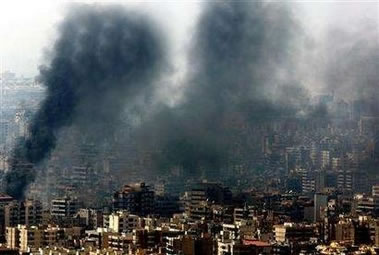
Note the Reuters modification of the lower left corner, and how miraculously new duplicate buildings have sprung up in the past 2 weeks, not to mention the fake photoshoped smoke.
I for one am glad that there are blogs like LGF that watch the MSM.
Funny and sad that one of the old role of the MSM was to watch the original watchmen, the government.
Background of the MSM gullibility if not culpability in broadcasting propaganda:
20060803
The Opposition
The essential problem of the left is moral and cultural relativism. Thus they seek equality for the sake of equality without consideration for morality or justice. Those that have only have because they took from those who do not have. The haves must be made to give back to those who don't have. This is the crux of the left domestic policy. Those that are strong must be oppressing those that are weak. The strong must be made weak. This is the crux of the left foreign policy.
Note that the ideology is to bring down the system rather than to actually help those who need help. Take from the rich rather than to make the poor richer. Weaken the strong rather than strengthen the weak. Currently the West (and the Israeli as pertains to the Middle East) are both prosperous and strong, thus they must be opposed with each breath.
Moral and cultural relativism is a rotten core belief yet it can perpetuate as long as there are those who have more and those who are stronger.
Note that the ideology is to bring down the system rather than to actually help those who need help. Take from the rich rather than to make the poor richer. Weaken the strong rather than strengthen the weak. Currently the West (and the Israeli as pertains to the Middle East) are both prosperous and strong, thus they must be opposed with each breath.
Moral and cultural relativism is a rotten core belief yet it can perpetuate as long as there are those who have more and those who are stronger.
20060730
Lebanon 3
A few days old but still relevant as we all track the military actions in South Lebanon. Varifrank reminds us that:
The hardest thing when fighting insurgents/terrorists is actually getting them to fight on your terms. When you set the conditions for the confrontation, you choose conditions that are favorable to victory. This applies to all enemies in general but against conventional forces, they fight on similar terms and their effectiveness is similar, though hopefully inferior, to yours. When you are fighting insurgents, if they were smart, they would recognize their inferior capability in a stand-up fight and thus would retreat when facing a conventional force. But when dealing with Islamofascist insurgents, who think that God is with them and will bring them victory based on their faith alone, their ego can be used to draw them out to fight, and thus be killed.
If Hezbollah thinks they have a fighting chance against Israel, then so much the better. If they don't think they have a chance but can get away, they will run. If they do not think they can get away due to the overwhelming number of Israeli forces, they may just hole up, which makes getting them out harder. Unless Israel is willing to bypass these bunkers and just level them flat. Which is what I believe is happening at Hexbollah strongholds. The willingness of Israel to flatten these areas is also suggested by their pre-attack warnings for civilians to evacuate and their disinterest in taking and holding territory.
With what is going on in Southern Lebanon currently, the fat lady hasn't even come on stage yet.
I’ve been watching the war from afar. I haven’t been able to comment daily as I’ve been really busy with real revenue generating work instead of blogging. But I have come to one conclusion based on what I’ve seen and what we’ve heard.
It’s all crap.
It’s not the usual bias that I’m complaining about. It's not the usual “reporting news the way they want things to be” as news instead of commentary that is going on.
It’s that I don’t think what is happening – or what is being reported as happening is necessarily what is happening.
Relax for a just second loyal readers, I’m not the "black helicopter" type, that’s not what I’m saying.
Here’s what I’m talking about. When you see news coming from Israel, its censored. That’s a good thing. I support that, its saving lives. When you see news from Beirut, its also censored. It’s also mostly propaganda. It’s a fact. I think were all over the age of 5 here, so I don’t think anyone who reads this blog is going to slap themselves in the head and shout “ Oh say it isn’t so!”
The hardest thing when fighting insurgents/terrorists is actually getting them to fight on your terms. When you set the conditions for the confrontation, you choose conditions that are favorable to victory. This applies to all enemies in general but against conventional forces, they fight on similar terms and their effectiveness is similar, though hopefully inferior, to yours. When you are fighting insurgents, if they were smart, they would recognize their inferior capability in a stand-up fight and thus would retreat when facing a conventional force. But when dealing with Islamofascist insurgents, who think that God is with them and will bring them victory based on their faith alone, their ego can be used to draw them out to fight, and thus be killed.
If Hezbollah thinks they have a fighting chance against Israel, then so much the better. If they don't think they have a chance but can get away, they will run. If they do not think they can get away due to the overwhelming number of Israeli forces, they may just hole up, which makes getting them out harder. Unless Israel is willing to bypass these bunkers and just level them flat. Which is what I believe is happening at Hexbollah strongholds. The willingness of Israel to flatten these areas is also suggested by their pre-attack warnings for civilians to evacuate and their disinterest in taking and holding territory.
With what is going on in Southern Lebanon currently, the fat lady hasn't even come on stage yet.
20060727
Lebanon 2
Over at The Belmont Club Wretchard has an excellent post regarding what may be Israel's strategic plan against Hezbollah. Read it all!
I also believe that in order for Israel to destroy Hezbollah now and future, they will need to do more than just "disarm" Hezbollah. Part of Hezbollah power, both practically and public relation wise, are the social services Hezbollah provides in Southern Lebanon. Practically, they are the de facto government in Southern Lebanon because the central government of Lebanon cannot "keep the trains running on time" sort to speak. And this translates to political power that grants them legitimacy regionally. And this also has endeared them to Europe, granting them international legitimacy in the eyes of some as well.
Thus this war presents a second opportunity for the central Lebanese government to reassert itself in Southern Lebanon. With international assistance, primarily US but also EU, the central government should do all it can (without Hezbollah) to rebuild and provide for Southern Lebanon after the ceasefire and while Hezbollah seek to rebuild itself and its paramilitary infrastructure.
This is how Hezbollah can be destroyed. Degrade its military forces in war; marginalize its social services in peace. Have to win both.
Reduced to its essentials, the IDF strategy may be ridiculously simple: fix the Hezbollah force in Southern Lebanon while detaching its command structure from the field by simultaneously striking Beirut. One of the great mysteries, upon which newpaper accounts shed no light, is why the IDF should so furiously pulverize Hezbollah's enclaves in southern Beirut, blockade the port and disable the airport. The object isn't to shut down Lebanon. It is to momentarily disorient the Hezbollah headquarters in Beirut, so that in a moment of absentmindedness, the Hezbollah forces in Southern Lebanon will do what comes most naturally: commit themselves against the IDF.
I also believe that in order for Israel to destroy Hezbollah now and future, they will need to do more than just "disarm" Hezbollah. Part of Hezbollah power, both practically and public relation wise, are the social services Hezbollah provides in Southern Lebanon. Practically, they are the de facto government in Southern Lebanon because the central government of Lebanon cannot "keep the trains running on time" sort to speak. And this translates to political power that grants them legitimacy regionally. And this also has endeared them to Europe, granting them international legitimacy in the eyes of some as well.
Thus this war presents a second opportunity for the central Lebanese government to reassert itself in Southern Lebanon. With international assistance, primarily US but also EU, the central government should do all it can (without Hezbollah) to rebuild and provide for Southern Lebanon after the ceasefire and while Hezbollah seek to rebuild itself and its paramilitary infrastructure.
This is how Hezbollah can be destroyed. Degrade its military forces in war; marginalize its social services in peace. Have to win both.
20060725
Gaza
Meanwhile on the Gaza front
Very interesting if true, that the Palestinians and Hamas have more sense than the Lebanese/Hezbollah. I laud this as the first wise strategic move from the Palestinians to move away from suicidal use of violence for nationhood.
At the same time, it kind of undermine the cause celebre of Hezbollah a bit doesn't it. Just demonstrating that Hezbollah's action is for Hezbollah/Syria/Iran rather than for Palestine, or for Lebanon.
All groups in Gaza, including Hamas, would now accept a cease-fire deal with Israel which would include releasing Gilad Shalit, according to the Palestinian Agriculture Minister, who also heads the coordinating committee of Palestinian organizations there.
Ibrahim Al-Naja said the factions were ready to stop the Qassam rocket fire if Israel's ceased all military moves against the Palestinian factions in Gaza. They are also ready to release Shalit in exchange for guaranteeing the future release of Palestinian prisoners.
Very interesting if true, that the Palestinians and Hamas have more sense than the Lebanese/Hezbollah. I laud this as the first wise strategic move from the Palestinians to move away from suicidal use of violence for nationhood.
At the same time, it kind of undermine the cause celebre of Hezbollah a bit doesn't it. Just demonstrating that Hezbollah's action is for Hezbollah/Syria/Iran rather than for Palestine, or for Lebanon.
20060724
Lebanon
What the government of Lebanon needs to do is to reassert is sovereignty. If they do not view Hezbollah actions against Israel as a threat to its sovereignty, then they in effect are accepting Hezbollah actions as legitimate actions of Lebanon. Under these condition Israel is making war against all of Lebanon and the Lebanese army needs to repel Israel. The Lebanese government must be able to militarily evict Israel, and or muster international support, military and or diplomatic, to do so. However, other than Iran, no other Middle Eastern nation are likely to do so. Syria will not risk injury and damage for the sake of Hezbollah, not to mention Lebanon.
However, if the Lebanese government view Hezbollah as a threat to itself as much as Israel's incursion, then there is an opportunity to address both.
Firstly, allow Israel to militarily degrade Hezbollah while responding to the humanitarian crisis and mustering the Lebanese army.
Secondly, broker a deal with Israel with international powers for the Lebanese army to occupy southern Lebanon and assume control from both Israel and Hezbollah. Thus avoiding foreign military forces in southern Lebanon.
Thirdly, disarm a weakened Hezbollah.
Update: From Debka regarding the behind the scene maneuvering in Lebanon with Rice's visit.
However, if the Lebanese government view Hezbollah as a threat to itself as much as Israel's incursion, then there is an opportunity to address both.
Firstly, allow Israel to militarily degrade Hezbollah while responding to the humanitarian crisis and mustering the Lebanese army.
Secondly, broker a deal with Israel with international powers for the Lebanese army to occupy southern Lebanon and assume control from both Israel and Hezbollah. Thus avoiding foreign military forces in southern Lebanon.
Thirdly, disarm a weakened Hezbollah.
Update: From Debka regarding the behind the scene maneuvering in Lebanon with Rice's visit.
Speaking privately to PM Fouad Siniora Monday, July 24, the secretary of state said, according to DEBKAfile’s exclusive Middle East sources: You don’t want to be like the Palestinian Authority which stands by and watches its people go to ruin.
Before taking off for Jerusalem, she also met Nabih Berri, the pro-Syrian Shiite parliamentary speaker. He said later their talks had failed but, according to DEBKAfile, they did arrive at some tactic understandings. Before moving against his Shiite rival Hassan Nasrallah and the Hizballah, Berri preferred to wait for the first cracks to appear in their standing.
The US secretary also interviewed anti-Syrian coalition leaders, known as the “March 14 Camp.” Druze leader Walid Jumblatt remarked that Nasrallah was behaving like Yasser Arafat in the 1982 siege of Beirut. “He is willing to let the Lebanese capital burn while he haggles over terms of surrender.”
The Christian leader Samir Geagea said: The situation is terrible but the calamity has created an opportunity which we must not miss.”
Rice stressed to all her Lebanese interlocutors that the United States had never planned to use Lebanon to fight Iran. Americans, she said, would never forget that Hizballah is a terrorist organization which has murdered Americans and other nationals. Hizballah has a problem not just with the US president but with both houses of congress.
She rejected pro-Syrian leaders’ demand for a ceasefire without first establishing its components. Washington is willing to consider a multinational force, or even a NATO presence, but would insist on the full implementation of Security Council resolution 1559, namely the disarming of Hizballah. This could take place in stages but, first of all, Hizballah must give up its rockets, missiles and heavy weapons.
Condoleezza Rice informed Siniora that she was representing the position President Bush had put before Saudi foreign minister Saud al-Faisal at the White House Sunday, July 23, implying that there was no point in the Lebanese running to the Saudis for help. They would have to cope with the crisis themselves
20060716
Pentagon Flight 77
When I moved to Arlington Virginia in December of 2001, the ruins of the Pentagon structures were still very much evident as it was a part of my daily commute. This video is incredible in deconstructing the event of that September morning.
20060710
Geneva Convention and PoW
This is the natural consequence of events surrounding the detainees at Guantanamo as played out in the left driven media and recent court decision. I support this stance whole heartedly.
The Geneva Convention had two intentions in mind. The first and foremost intention is the protection of innocent civilians in areas of conflict. This intention is achieved by differentiating combatants from civilians based on dress code and uniform. An enemy combatant masquerading as a civilian would put the lives of all nearby civilians at risks, thus is not protected by the Geneva Convention. The terrorists clearly fall outside of the Geneva Convention based on this criteria alone.
Secondly, the Geneva Convention seeks to protect legal combatants taken as prisoners of war. This is achieved primarily based on good faith, that "I will take care of your captured legal combatants and you will do similar with mine." The terrorists' regular execution of captured, both civilians and legal combatants, have demonstrated that there can be no good faith in this regard. If our captured are to be executed, we should consider the same.
Of note is that there is no room to put on trial enemy combatants captured. If they are illegal combatants, they could be executed without trials. If they are captured as prisoner of war and good faith is maintained, then there is no room for a "show trial" of any sort. If there is no good faith, then the Geneva Convention does not apply and a trial is not necessary.
HT Powerline
Also at WILLisms
Violent Islamist extremists must be killed on the battlefield. Only in the rarest cases should they be taken prisoner. Few have serious intelligence value. And, once captured, there's no way to dispose of them.
Killing terrorists during a conflict isn't barbaric or immoral - or even illegal. We've imposed rules upon ourselves that have no historical or judicial precedent. We haven't been stymied by others, but by ourselves.
The oft-cited, seldom-read Geneva and Hague Conventions define legal combatants as those who visibly identify themselves by wearing uniforms or distinguishing insignia (the latter provision covers honorable partisans - but no badges or armbands, no protection). Those who wear civilian clothes to ambush soldiers or collect intelligence are assassins and spies - beyond the pale of law.
Traditionally, those who masquerade as civilians in order to kill legal combatants have been executed promptly, without trial. Severity, not sloppy leftist pandering, kept warfare within some decent bounds at least part of the time. But we have reached a point at which the rules apply only to us, while our enemies are permitted unrestricted freedom.
The present situation encourages our enemies to behave wantonly, while crippling our attempts to deal with terror.
Consider today's norm: A terrorist in civilian clothes can explode an IED, killing and maiming American troops or innocent civilians, then demand humane treatment if captured - and the media will step in as his champion. A disguised insurgent can shoot his rockets, throw his grenades, empty his magazines, kill and wound our troops, then, out of ammo, raise his hands and demand three hots and a cot while he invents tales of abuse.
Conferring unprecedented legal status upon these murderous transnational outlaws is unnecessary, unwise and ultimately suicidal. It exalts monsters. And it provides the anti-American pack with living vermin to anoint as victims, if not heroes.
Isn't it time we gave our critics what they're asking for? Let's solve the "unjust" imprisonment problem, once and for all. No more Guantanamos! Every terrorist mission should be a suicide mission. With our help.
The Geneva Convention had two intentions in mind. The first and foremost intention is the protection of innocent civilians in areas of conflict. This intention is achieved by differentiating combatants from civilians based on dress code and uniform. An enemy combatant masquerading as a civilian would put the lives of all nearby civilians at risks, thus is not protected by the Geneva Convention. The terrorists clearly fall outside of the Geneva Convention based on this criteria alone.
Secondly, the Geneva Convention seeks to protect legal combatants taken as prisoners of war. This is achieved primarily based on good faith, that "I will take care of your captured legal combatants and you will do similar with mine." The terrorists' regular execution of captured, both civilians and legal combatants, have demonstrated that there can be no good faith in this regard. If our captured are to be executed, we should consider the same.
Of note is that there is no room to put on trial enemy combatants captured. If they are illegal combatants, they could be executed without trials. If they are captured as prisoner of war and good faith is maintained, then there is no room for a "show trial" of any sort. If there is no good faith, then the Geneva Convention does not apply and a trial is not necessary.
HT Powerline
Also at WILLisms
20060704
Academic Independence
Happy Independence America!
On the topic of Independence, consider this item on the Academic Independence:
What are the items in particular?
The Full Bill of Rights
HT Powerline
On the topic of Independence, consider this item on the Academic Independence:
DENVER -- Three years ago, David Horowitz came to Colorado to promote his newly inked Academic Bill of Rights, a plan the radical-turned-conservative activist said was needed to liberate students from an oppressive atmosphere of liberal groupthink at the nation's universities.
Critics had scoffed at the assertion by Mr. Horowitz -- who in the 1960s had been a prominent left-wing student activist -- that freedom on 21st-century campuses was being crushed by a tyrannical regime of political correctness.
But as then-state Senate Majority Leader John Andrews listened to Mr. Horowitz over breakfast at the Brown Palace Hotel, he agreed the time was ripe for an intellectual revolution.
"We were finishing each other's sentences, because this has been a concern for conservatives for such a long time," Mr. Andrews recalled. "I started working on and researching legislation right away."
A few months later, the Colorado legislature became the first to broker a deal with state universities on policies to protect students from political discrimination.
Since then, the Academic Bill of Rights, which says students should be graded and faculty should be hired and promoted without regard to their political or religious beliefs, has inspired the introduction of legislation in 18 states. Ohio and Tennessee struck deals with their universities on protecting academic freedom in lieu of legislation.
Meanwhile, Students for Academic Freedom, the campus watchdog group founded by Mr. Horowitz, has established chapters on more than 150 campuses
What are the items in particular?
1. Faculty members shall be hired and fired based on their competence and expertise, not their political or religious beliefs.
2. No faculty member shall be excluded from hiring, firing or tenure committees based on political or religious beliefs.
3. Students will be graded solely on their knowledge of a subject matter, not political or religious beliefs.
4. Reading lists should reflect a broad range of knowledge within a discipline.
5. Faculty will expose students to a wide range of viewpoints, not use their courses "for the purpose of political, ideological, religious or anti-religious indoctrination.
6. Campus speakers should reflect a broad range of viewpoints.
7. Efforts to censor viewpoints by obstructing invited speakers or destroying literature will not be tolerated.
8. Academic institutions and professional societies should maintain a position of organizational neutrality on scholarly disputes over resea
The Full Bill of Rights
HT Powerline
20060703
20060702
Inconvenient Truth: Kyoto
Want to know the consequences of the US not signing the Kyoto Protoco? From The Business Online:
Well wishes and intention are not enough to change the world. Legislation without basis in practical reality won't either.
HT: No Parasan
THE United States has frozen its carbon dioxide emissions at a time when signatories of the Kyoto Protocol are conceding that they cannot meet their own targets, according to official figures released last week.
While the American economy grew by 3.5% last year, more than twice the European average, its fossil fuel emissions were up by only 0.1% – with no growth in road pollution and a drop in aircraft emissions.
Its progress came as several members of the European Union (EU) missed the deadline to submit new targets to reduce their carbon footprint with Germany demanding an opt-out for its power stations and Spain and Portugal preparing to abandon their target.
The US Energy Department said last week that rising fuel prices had a profound effect on its economy, encouraging the shift to more efficient technology and seeing a decline in carbon usage, which many European countries would find enviable.
The oil price rises hit the US proportionately harder as its petrol is taxed at a lower rate. Pump prices in the United States jumped 19% to 61cents (35.2p) a litre while UK prices rose by just 3.6% to 89.4p a litre with similar rises across Europe.
Road pollution increases were halted across the US and aircraft CO2 emissions declined. American industry reduced its carbon emissions overall by 3.3% – a trend reflecting the economic shift from manufacturing
Since 1997, when the Kyoto Protocol was first signed, the US has now made more progress in reducing its per capita fossil fuel emissions than the UK, France, Spain, Finland, Sweden and Japan – even before its economic growth is considered.
The US is frequently criticised for having the highest CO2 emissions in the world – 19.5 tons per person. This is more than twice the level of Britain, at 9.5 tons a head, which itself is sharply ahead of nuclear-driven France at 6.8 tons a head.
The Bush administration has said this is because the US generates more wealth than any country in the world, and it has instead said carbon emissions should be judged as a function of economic wealth created, not per capita.
Although President George Bush pulled out of the Kyoto Protocol in 2001, after a bipartisan vote in Congress, America has made substantially more progress than its European counterparts, which are still signed up to reach its targets.
The EU has moved to a new flagship environment policy called the Emissions Trading Scheme (ETS), and all 25 member states were due by the end of last week to have submitted their carbon reduction targets for the period from 2008 to 2012.
Those countries that went public with their plans had low ambitions. The German government said last week it would be able to reduce its carbon emissions by only 1% by 2012 and has said this will not apply to its new power plants.
David Miliband, UK Environment Secretary, acknowledged last week that the government is “off track” in meeting its own target of reducing emissions by 20% under the 1990 baseline set by Kyoto. It has met the 10% target.
Spanish carbon emissions were 48% above the 1990 base in 2004, more then treble the 15% limit of its Kyoto target. Portugal, Greece and Ireland – also Kyoto signatories – all have emissions at least 20% higher
Of the 30 industrialised countries which signed Kyoto, 17 were exceeding their targets at the time the last count was taken, in 2004. Japan pledged itself to a 6% drop in its 1990 emissions levels, yet has so far experienced a 7% rise.
The main US increase was registered from air conditioning, reflecting an economic boom in America’s hotter states. Arizona’s economy grew by an extraordinary 8.7% over the year and Nevada’s by 8.2% – both on a par with the growth rates in India.
Well wishes and intention are not enough to change the world. Legislation without basis in practical reality won't either.
HT: No Parasan
20060629
Guantanamo Trials
The US Supreme Court has ruled against military tribunal trials for detainees at Guantanamo.
The as per the Geneva Convention, PoW cannot be put on trial by their captors. This stands to reason as there can only be one outcome of any such trials: Guilty! We should treat the Guantanamo detainees the same way. As we cannot and should not put the detainees on trial, and we should not and must not release them to commit more acts of terrorism, they should be detained until the War on Terror is won, or until their State of origin requests their return.
Update
From the WSJ
As I suggested, we should just keep them as detainees without trials, military or civilian.
WASHINGTON -- The U.S. Supreme Court, in major defeat for President George W. Bush's administration, blocked the U.S. military's current terrorism tribunal system, ruling 5-3 the commission's "structure and procedures" violate both military rules and the Geneva Conventions.
Justice John Paul Stevens, in a decision that drew five votes on significant points, said the military must revamp the system. "We conclude that the military commission convened to try Hamdan lacks power to proceed because its structure and procedures violate both the Uniform Code of Military Justice and the Geneva Conventions," Justice Stevens wrote.
In hearing the case of detainee Salim Ahmed Hamdan, the high court was reviewing several matters, including the ability of the U.S. military to try terrorism suspects held in Guantanamo Bay outside prisoner-of-war procedures and the legality of a 2005 congressional act restricting Supreme Court review of those cases.
The as per the Geneva Convention, PoW cannot be put on trial by their captors. This stands to reason as there can only be one outcome of any such trials: Guilty! We should treat the Guantanamo detainees the same way. As we cannot and should not put the detainees on trial, and we should not and must not release them to commit more acts of terrorism, they should be detained until the War on Terror is won, or until their State of origin requests their return.
Update
From the WSJ
The Supreme Court's decision in Hamdan v. Rumsfeld, invalidating for now the use of military commissions to try al Qaeda and associated detainees, may be a setback for U.S. policy in the war on terror. But it is a setback with a sterling silver lining. All eight of the justices participating in this case agreed that military commissions are a legitimate part of the American legal tradition that can, in appropriate circumstances, be used to try and punish individuals captured in the war on terror. Moreover, nothing in the decision suggests that the detention facility at Guantanamo Bay must, or should, be closed.
Indeed, none of the justices questioned the government's right to detain Salim Ahmed Hamdan (once Osama bin Laden's driver), or other Guantanamo prisoners, while hostilities continue. Nor did any of them suggest that Mr. Hamdan, or any other Guantanamo detainee, must be treated as civilians and accorded a speedy trial in the civilian courts. Precisely because opponents of the Bush administration's detention policies have advanced these, or substantially similar claims, Hamdan has dealt them a decisive defeat. Together with the Supreme Court's 2004 decision in Hamdi v. Rumsfeld -- directly affirming the government's right to capture and detain, without criminal charge or trial, al Qaeda and allied operatives until hostilities are concluded -- Hamdan vindicates the basic legal architecture relied upon by the administration in prosecuting this war.
As I suggested, we should just keep them as detainees without trials, military or civilian.
20060614
Inconvenient Truth behind the "Inconvenient Truth"
What exactly is the truth and science behind global warming? Is it really an Inconvenient Truth?
HT Roger Simon
Appearing before the Commons Committee on Environment and Sustainable Development last year, Carleton University paleoclimatologist Professor Tim Patterson testified, "There is no meaningful correlation between CO2 levels and Earth's temperature over this [geologic] time frame. In fact, when CO2 levels were over ten times higher than they are now, about 450 million years ago, the planet was in the depths of the absolute coldest period in the last half billion years." Patterson asked the committee, "On the basis of this evidence, how could anyone still believe that the recent relatively small increase in CO2 levels would be the major cause of the past century's modest warming?"
HT Roger Simon
20060613
the Left
George W Bush went to Iraq today, and returned safely. But I wonder what the news would have been like had he been killed. Would there be glee from the left that an American President has been killed?
20060608
20060529
Memorial day


Honor those who served, still missing in action, interred in rest, and living victorious. From the WSJ.
Here's a Memorial Day quiz:
1. Who is Jessica Lynch?
Correct. She's the Army private captured, and later rescued, in the early days of the war.
2. Who is Leigh Ann Hester?
Come on. The Kentucky National Guard vehicle commander was awarded a Silver Star last year for fighting off an insurgent attack on a convoy in Iraq. The first woman to receive a Silver Star since World War II, and the first woman ever to receive one for close combat.
If you don't recognize Sergeant Hester's name, that's not surprising. While Private Lynch's ordeal appears in some 12,992 newspaper and broadcast reports on the Factiva news service, Sergeant Hester and her decoration for extraordinary valor show up in only 162.
One difference: Sergeant Hester is a victor, while Private Lynch can be seen as a victim. And when it comes to media reports about the military these days, victimology is all the rage. For every story about someone who served out of conviction and resolutely went on with his civilian life, there are many more articles about a soldier's failure or a veteran's floundering.
It's a sign of some progress that the men and women returning from Iraq and Afghanistan are not spit upon and shunned as Vietnam vets were. Yet there may be something more pernicious about mouthing "Support Our Troops" while also asserting that many of them are poor, uneducated dupes who were cannon fodder overseas and have come home as basket cases, plagued by a range of mental, emotional and financial problems.
The vast majority of vets don't fit that description. Many, like one returned Army guardsman we talked to, chalk up this portrayal to the media's fascination with bad news in general. As for his combat in Iraq, both "going to war and coming home is very overwhelming," he says. "But you make choices in life . . . and through inner strength and support, I am making a choice that I want to be healthy."
In some cases, the depiction of military personnel as damaged goods serves the antiwar agenda. Yet retired Marine Lieutenant Colonel Tom Linn sees more basic impulses at work. "I honestly believe it is guilt" and even resentment, he says. The military type as misfit "is a stereotype that a lot of people from the Vietnam era have held on to." Then, as now, "they saw men and women who did more than they did . . . and they'd compensate by casting those folks in an inferior status."
This Memorial Day, most of us will remember the Americans who have served their country since the Revolutionary War not with pity but with admiration. For those who want to show their gratitude, Major John Morris has some recommendations. He's deputy chaplain for Minnesota's Army National Guard and a founder of a state program called Reintegration: Beyond Reunion. Its broad goal, he explains, is to help returning guardsmen and reservists frame their "experience, to draw from it everything that they can to grow into productive citizens."
How can we help? For one thing, he says, don't assume that all struggling vets are sick, since what looks like abnormal behavior may be culture shock. But do give vets and their families the tools to adjust. Major Morris explains: "Schools, look out for these military kids. Neighbors, cut their grass and shovel their snow, babysit and do chores around the house. Employers, make sure those jobs are still there." It's the least we can do, he says: "Since there are so few of us fighting the war, it's easy for the rest of us to try."
20060526
Immigration 2: Legal Residency Instead of Citizenship
Previously I considered allowing illegal immigrants the opportunity to become citizens. I now think a better idea would be to allow them legal resident status but do not grant them citizenship. As legal residents they would be protected by the law and be eligible for medicare and medicaid, but not be eligible for social security or voting rights. As any comprehensive immigration policy must include boder security, I would expect the total numbers of illegal immigrants to decline with time, as well as a proportionate decline in the number of illegal immigrants who become legal residents.
20060509
Victory in Iraq 2
Interesting report from Powerline and Ed Morrisey
Again, observe how Al Qaeda strategy involves playing our media. And amazingly, our media appear to be all willing accomplists.
1. It has been proven that the Shiites have a power and influence in Baghdad that cannot be taken lightly, particularly when the power of the Ministries of Interior and Defense is given to them, compared with the power of the mujahidin in Baghdad. During a military confrontation, they will be in a better position because they represent the power of the state along with the power of the popular militias. Most of the mujahidin power lies in surprise attacks (hit and run) or setting up explosive charges and booby traps. This is a different matter than a battle with organized forces that possess machinery and suitable communications networks. Thus, what is fixed in the minds of the Shiite and Sunni population is that the Shiites are stronger in Baghdad and closer to controlling it while the mujahidin (who represent the backbone of the Sunni people) are not considered more than a daily annoyance to the Shiite government. The only power the mujahidin have is what they have already demonstrated in hunting down drifted patrols and taking sniper shots at those patrol members who stray far from their patrols, or planting booby traps among the citizens and hiding among them in the hope that the explosions will injure an American or members of the government. In other words, these activities could be understood as hitting the scared and the hiding ones, which is an image that requires a concerted effort to change, as well as Allah’s wisdom.
2. The strength of the brothers in Baghdad is built mainly on booby trapped cars, and most of the mujahidin groups in Baghdad are generally groups of assassin without any organized military capabilities.
3. There is a clear absence of organization among the groups of the brothers in Baghdad, whether at the leadership level in Baghdad, the brigade leaders, or their groups therein. Coordination among them is very difficult, which appears clearly when the group undertake a join operations
4. The policy followed by the brothers in Baghdad is a media oriented policy without a clear comprehensive plan to capture an area or an enemy center. Other word, the significance of the strategy of their work is to show in the media that the American and the government do not control the situation and there is resistance against them. This policy dragged us to the type of operations that are attracted to the media, and we go to the streets from time to time for more possible noisy operations which follow the same direction.
This direction has large positive effects; however, being preoccupied with it alone delays more important operations such as taking control of some areas, preserving it and assuming power in Baghdad (for example, taking control of a university, a hospital, or a Sunni religious site).
At the same time, the Americans and the Government were able to absorb our painful blows, sustain them, compensate their losses with new replacements, and follow strategic plans which allowed them in the past few years to take control of Baghdad as well as other areas one after the other. That is why every year is worse than the previous year as far as the Mujahidin’s control and influence over Baghdad.
5. The role that the Islamic party and the Islamic Scholars Committee play in numbing the Sunni people through the media is a dangerous role. It has been proven from the course of the events that the American investment in the Party and the Committee were not in vain. In spite of the gravity of the events, they were able to calm down the Sunni people, justify the enemy deeds, and give the enemy the opportunity to do more work without any recourse and supervision. This situation stemmed from two matters:
First, their media power is presented by their special radio and TV stations as the sole Sunni information source, coupled with our weak media which is confined mainly to the Internet, without a flyer or newspaper to present these events.
Second, in the course of their control of the majority of the speakers at mosques who convert right into wrong and wrong into right, and present Islam in a sinful manner and sins in a Muslim manner. At the same time we did not have any positive impact or benefits from our operations.
6. The mujahidin do not have any stored weapons and ammunition in their possession in Baghdad, particularly rockets, such as C5K Katyosha or bomber or mortars which we realized their importance and shortage in Baghdad. That was due to lack of check and balance, and proper follow-ups.
7. The National Guard status is frequently raised and whether they belong to the Sunnis or Shiites. Too much talk is around whether we belong to them or not, or should we strike and kill their men or not?
It is believed that this matter serves the Americans very well. I believe that the Committee and the Party are pushing this issue because they want to have an influence, similar to the Mujahidin’s. When and if a Sunni units from the National Guard are formed, and begin to compete with the mujahidin and squeeze them, we will have a problem; we either let them go beyond the limits or fight them and risk inciting the Sunnis against us through the Party’s and the Committee’s channels.
I believe that we should not allow this situation to exist at all, and we should bury it before it surfaces and reject any suggestion to that effect.
Again, observe how Al Qaeda strategy involves playing our media. And amazingly, our media appear to be all willing accomplists.
20060508
Islamism and Terrorism 2
There are two problems at hand here. One is with with Islam itself. The other is the adoption of Sharia as legal precendence (i.e. the lack of separation between church and state). Efforts to reform Islam such as this one by Malek Chebel are being proposed:
With regards to separation of church and state, the state will only reform when it sees a threat. That threat has now been recognized in the form of terrorism. Saudi Arabia is moving toward reforms to minimize the terrorism threat.
Country Terrorism Report: Saudi Arabia
Saudi Effort Draws on Radical Clerics to Combat Lure of Al-Qaeda
Saudis to Clean Up Libraries
In addition, effective reform must also come from the people.
Learning to Think and Tolerate Differences in Saudi Society
Saudi Human Rights Organization
Why must we fight?
Part of me died when I saw this cruel killing.
*Update* Atwar Bahjat Beheading Video a Hoax
United 93
Also:
Islamism and Terrorism 1
"Allahu Akbar" Indeed at All Things Beautiful
In his Manifesto for an Enlightened Islam (Manifeste pour un islam des lumières), Chebel puts forth 27 proposals for extensively reforming Islam. He turns to the values of the 18th-century European Enlightenment for guidance, when rationalism and secularism guided the drive towards cultural, social and political progress. Chebel's first two propositions set the principles of reform: a new interpretation of the Koran, and the preeminence of reason over creed. However, he dismisses atheism, noting that "nothing very important is achieved outside the framework of religion." [1]
Chebel calls for putting an end to violence in the name of Islam; for renouncing Jihad, which is, in his eyes, immoral; for abolishing all fatwas calling for death; and for abolishing Islamic corporal punishment. Chebel stands against female genital mutilation and for banning slavery and trafficking in human beings in the Arab world; for strict punishment of the perpetrators of honor crimes and for promoting the status of women.
Most of Chebel's propositions deal with politics: He advocates an independent judiciary, the preeminence of the individual over the Islamic nation, and the struggle against political assassinations in an effort to promote democracy in the Arab world. He also advocates fundamental cultural changes, such as turning freedom of thought into a Muslim value, renouncing the cult of personality, respecting the other, and fighting corruption.
His other propositions address technology, bioethics, ecology, and the media. The last one reaffirms the preeminence of human beings over religion. Chebel's propositions aim at providing keys to a modern, reformed, enlightened Islam.
With regards to separation of church and state, the state will only reform when it sees a threat. That threat has now been recognized in the form of terrorism. Saudi Arabia is moving toward reforms to minimize the terrorism threat.
Country Terrorism Report: Saudi Arabia
Saudi Effort Draws on Radical Clerics to Combat Lure of Al-Qaeda
Saudis to Clean Up Libraries
In addition, effective reform must also come from the people.
Learning to Think and Tolerate Differences in Saudi Society
Saudi Human Rights Organization
Why must we fight?
Part of me died when I saw this cruel killing.
*Update* Atwar Bahjat Beheading Video a Hoax
United 93
Also:
Islamism and Terrorism 1
"Allahu Akbar" Indeed at All Things Beautiful
20060506
Bigot Crossings
From the Richmond Times-Dispatch:
Interesting how what popular impression is different once analyzed.
Which party has more bigots -- Republicans or Democrats?
Conventional wisdom says the GOP. After all, the vast majority of African-Americans vote Democratic, and the establishment media frequently imply the GOP harbors hostility to minorities (as in the comment by a network correspondent that a GOP effort to project an "image of tolerance and diversity [is] starkly at odds with reality").
A recent analysis by Yale's Ebonya Washington in the Quarterly Journal of Economics sheds a different light on the question. It examines the phenomenon of crossover voting -- specifically, the percentage of voters from either party who pull the lever for the other party's candidate.
In the several elections between 1982 and 2000 that Ms. Washington studied, when the Republican congressional candidate was black and the Democratic candidate was not, Republican crossover voting increased 25 percent. In gubernatorial contests with the same racial dynamic, GOP crossover voting increased 18 percent.
Now flip the script. When the Democratic candidates were black and the Republican candidates were not, Democratic crossover votes increased 38 percent in congressional contests and 20 percent in gubernatorial contests.
In short, Democrats flee from black candidates more often than Republicans do.
Interesting how what popular impression is different once analyzed.
20060504
Taxes: Cuts and Income
As this WSJ article suggests, we should focus on total revenue rather than sticking it to the tax payers.
With the House and Senate preparing to vote on extending George W. Bush's investment tax cuts, it's no surprise the cries against "tax giveaways to the rich" grow increasingly shrill. Just yesterday Senate Minority Leader Harry Reid charged that the Bush tax plan "offers next to nothing to average Americans while giving away the store to multi-millionaires" and then fumed that it will "do much more for ExxonMobil board members than it will do for ExxonMobil customers."
Oh really. New IRS data released last month tell a very different story: In the aftermath of the Bush investment tax cuts, the federal income tax burden has substantially shifted onto the backs of the wealthy. Between 2002 and 2004, tax payments by those with adjusted gross incomes (AGI) of more than $200,000 a year, which is roughly 3% of taxpayers, increased by 19.4% -- more than double the 9.3% increase for all other taxpayers.
Between 2001 and 2004 (the most recent data), the percentage of federal income taxes paid by those with $200,000 incomes and above has risen to 46.6% from 40.5%. In other words, out of every 100 Americans, the wealthiest three are now paying close to the same amount in taxes as the other 97 combined. The richest income group pays a larger share of the tax burden than at anytime in the last 30 years with the exception of the late 1990s -- right before the artificially inflated high tech bubble burst.
Millionaires paid more, too. The tax share paid by Americans with an income above $1 million a year rose to 17.8% in 2003 from 16.9% in 2002, the year before the capital gains and dividend tax cuts.
The most astounding result from the IRS data is the deluge of revenues from the very taxes that were cut in 2003: capital gains and dividends. As shown in the nearby chart, capital gains receipts from 2002-04 have climbed by 79% after the reduction in the tax rate from 20% to 15%. Dividend tax receipts are up 35% from 2002 to 2004, even though the taxable rate fell from 39.6% to 15%. This is as clear evidence of a Laffer Curve effect as one will find: Lower rates produced increased revenues.
What explains this surge in tax revenues, especially at the high end of the income scale? The main factor at play here is the robust economic expansion, which has led to real income gains for most tax filers. Higher incomes mean higher tax payments. Between 2001 and 2004, the percentage of Americans with an income of more than $200,000 rose from 12.0% to 14.2%. The percentage of Americans earning more than $50,000 a year rose from 40.8% to 44.2% -- and that's just in two years. While these statistics are not inflation-adjusted by the IRS, price rises were relatively modest during these years, so adjusting wouldn't alter much.
We can already hear the left objecting that the rich are paying more taxes simply because they have hoarded all the income gains, while the middle class and poor wallow in economic quicksand. But, again, the IRS data tell a more upbeat story of widespread financial gains for American families. The slice of the total income pie captured by the richest 1%, 5% and 10% of Americans is lower today than in the last years of the Clinton administration.
So how can the media contort these statistics to conclude that the Bush tax cuts only benefited the affluent? The New York Times claims that the richest 0.1% got 5,000 times the tax benefit than those with less than $50,000 of income. That figure can only be true if one assumes that there were no economic benefits from the tax cuts whatsoever; and that lower taxes on income, capital gains and dividends resulted in no changes in the real economy -- not the value of stocks, not business spending, not employment, not capital flows into the U.S., not corporate dividend payments, not venture capital funding -- nothing. The underlying assumption of this static analysis is that tax cuts don't work and that incentives don't matter.
Of course, in the real world, financial incentives through tax policy changes matter a great deal in altering economic behavior. And we now have the evidence to confirm that the latest round of tax cuts worked -- five million new jobs, a 25% increase in business spending, 4% real economic growth for three years and a $4 trillion gain in net wealth. So now the very class-warfare groups who, three years ago, swore that the tax cuts would tank the economy rather than revive it, pretend that this robust expansion would have happened without the investment tax cuts. Many Democrats on Capitol Hill recite this fairy tale over and over.
One final footnote to this story: Just last week, the Department of the Treasury released its tax receipt data for March 2006. Tax collections for the past 12 months have exploded by 14.4%. We are now on course for a two-year increase in tax revenues of at least $500 billion, the largest two-year increase in tax revenue collections after adjusting for inflation ever recorded. So why are the leftists complaining so much? George Bush's tax rate cuts have been among the most successful policies to soak the rich in American history.
Mr. Moore is a member of The Wall Street Journal's editorial board.
Moussaoui 2
Now that the Jury has sentenced him to life. I still believe as I did in Moussaoui with additional thoughts:
Firstly, the death penalty should be reserved for those actually guilty of having commited a grievious crime, not just for having planned to participate in one.
Secondly, why are we even treating terrorism as a law and order problem for this to be in a court of law? We should treat terrorism as an act of war. We should either hold them as PoW, as illegal combatants, or execute them as spies. All such options are in compliance with the Geneva convention.
Neo-neocon for more thoughts.
In From the Cold for where he is likely to spend his remaining days.
As long as he is not sent to France
Firstly, the death penalty should be reserved for those actually guilty of having commited a grievious crime, not just for having planned to participate in one.
Secondly, why are we even treating terrorism as a law and order problem for this to be in a court of law? We should treat terrorism as an act of war. We should either hold them as PoW, as illegal combatants, or execute them as spies. All such options are in compliance with the Geneva convention.
Neo-neocon for more thoughts.
In From the Cold for where he is likely to spend his remaining days.
As long as he is not sent to France
20060423
20060420
Asia
The future is Asia. As a Pacific nation, the US should reaffirm our economic and military alliance with Japan and Australia. The US should also reach out to rising powers of India and China. Both India and China should be engaged as future partners for cooperation and competition rather than competition alone. First economic, later military.
We should turn our gaze away from Eurabia.
More on this later.
We should turn our gaze away from Eurabia.
20060417
Generals in war, 5 vs. 6
From today's WSJ Editorial pages by JOHN CROSBY, THOMAS MCINERNEY, BURON MOORE AND PAUL VALLELY. The last paragraph is really all you need to read:
It doesn't really matter why the six retired generals are now speaking up in near unison, or what their motives are. Let me repeat the money phrase:
No war has ever been fought with perfect forsight and planning. Even so, with all the misteps thus, the last six years the US military had seen unprecendented success on the battlefield.
Foes of the Bush administration described the recent calls by six retired generals for Donald Rumsfeld to resign or be fired as "growing military pressure" for him to do so. These retired generals claim he should go for, among other things, ignoring the advice of senior military leaders and bungling the global war on terror in Iraq with poorly planned war-fighting strategies and post-Saddam planning efforts. We strongly disagree.
Like former Chairman of the Joint Chiefs of Staff Gen. Richard Myers, we do not believe that it is appropriate for active duty, or retired, senior military officers to publicly criticize U.S. civilian leadership during war. Calling for the secretary's resignation during wartime may undercut the U.S. mission and incites individual challenge to the good order and discipline of our military culture. At best, such comments may send a confusing message to our troops deployed on dangerous missions in Afghanistan and Iraq. At worst, they can also inspire and motivate the evil forces we seek to defeat.
Since our nation's founding, the principle of civilian control over the military has been a centerpiece of our system of government. Under our constitutional system, it places elected and appointed government leaders in charge. American soldiers are bound by this tradition to subordinate themselves to civilian authority. We give advice but it is ultimately up to civilian leaders to make key strategic and policy decisions. Unlike many other democracies, this is one important reason why we have never been ruled by the military, and have been the most successful country the world has ever seen.
Some critics suggest that the calls by the six retired generals signify widespread discontent in the military with Secretary Rumsfeld's leadership. It is preposterous for them to suggest that this small group represents the views of the 1.4 million men and women serving on active duty or the 7,000 retired generals and flag officers who respect, understand and appreciate the established American tradition of the military being subordinate to civilian control and direction.
Moreover, despite the frustration of the current situation in Iraq, military morale remains high, as evidenced by the high re-enlistment rate of active-duty forces. This fact belies the contention that there is rising military discontent.
The notion that Secretary Rumsfeld doesn't meet with, or ignores the advice of, senior military leaders is not founded in fact. During his tenure, senior military leaders have been involved to an unprecedented degree in every decision-making process. In addition to the Senior Level Review Group, Defense Senior Leadership Conference, and Quadrennial Defense Review, in 2005 Secretary Rumsfeld also participated in meetings involving service chiefs 110 times and combatant commanders 163 times. Gen. Myers correctly describes these meetings as "very collaborative" with a free flow of information and discussion. Gen. Tommy Franks, U.S. Central Command Commander during the liberation of Afghanistan and Iraq, echoes Gen. Myers's comments and supports Secretary Rumsfeld as collaborative in the decision-making process. Gen. Franks has stated recently that he is a tough collaborator and demands sound thinking and recommendations from the senior military leadership and staff.
Much of the acrimony expressed by Secretary Rumsfeld's military critics appears to stem from his efforts to "transform" the military by moving to a joint expeditionary force that is lighter and more mobile in nature to meet the nation's current and future threats. Many senior officers and bureaucrats did not support his transformation goals -- preferring conventional weapons of the past like the Crusader artillery piece and World War II war-fighting strategies, which prove practically useless against lawless and uncivilized enemies engaged in asymmetric warfare. It unfortunately appears that two of the retired generals (Messrs. Zinni and Newbold) do not understand the true nature of this radical ideology, Islamic extremism, and why we fight in Iraq. We suggest they listen to the tapes of United 93.
Despite criticisms, Mr. Rumsfeld is arguably one of the most effective secretaries of defense our nation has ever had. Under his watch, the U.S. military has been transforming; it brilliantly deposed Mullah Omar's barbaric Taliban regime (Osama bin Laden's sanctuary) and Saddam Hussein's ruthless Baathist regime, freeing 50 million people from oppression and placing the countries on democratic paths. With these actions, terrorists have been denied secure home bases. These are a few key factors why terrorists have been unable to attack the American homeland again. The policy and forward strategy implemented by Secretary Rumsfeld has taken the fight to the enemy as did the nation in World War II and the Cold War.
Some, like Generals Zinni, Newbold, Eaton, Batiste, Swannack, Riggs and others, may not like Secretary Rumsfeld's leadership style. They certainly have the right as private citizens now to speak their minds. Some may feel that he's been unfair, arrogant and autocratic to some senior officers. But those sentiments and feelings are irrelevant. In the end he's the man in charge and the buck stops with him. As long as he retains the confidence of the commander in chief he will make the important calls at the top of the department of defense. That's the way America works. So let's all breathe into a bag and get on with winning the global war against radical Islam. In time the electorate, and history, will grade their decisions.
Lt. Gen. Crosby (ret.) is former deputy commanding general of the U.S. Army Training and Doctrine Command. Lt. Gen. McInerney (ret.) is former assistant vice chief of staff, U.S. Air Force. Maj. Gen. Moore (ret.), U.S. Air Force, was director of Central Command during Operation Desert Storm. Maj. Gen. Vallely (ret.) is former deputy commander of the U.S. Army, Pacific.
It doesn't really matter why the six retired generals are now speaking up in near unison, or what their motives are. Let me repeat the money phrase:
In the end he's the man in charge and the buck stops with him. As long as he [Rumsfeld] retains the confidence of the commander in chief he will make the important calls at the top of the department of defense. That's the way America works. So let's all breathe into a bag and get on with winning the global war against radical Islam. In time the electorate, and history, will grade their decisions.
No war has ever been fought with perfect forsight and planning. Even so, with all the misteps thus, the last six years the US military had seen unprecendented success on the battlefield.
20060408
Immigration
I am for legal immigration. Perhaps I am bias for being a legal immigrant myself. Never the less I do recognize the problems of illegal immigrants. My thoughts are as follow.
1. We must make it easier for foreigners to immigrate here to meet our labor needs. These guess workers must be screened prior to entry and tracked, taxed, and identified. After a set period of time, they should be able to apply for citizenship.
2. We must secure the border. If it takes a wall, so be it. But it must start with more regular and more vigilant patrols.
3. Those here illegally must apply to stay as guess workers, with possibility for citizenship. Those that fail the guess worker application must be deported.
4. Citizenship requires a test covering the constitution of the land and the political processes. The language of the land should be English but xceptions can be made for children and the elderly. While expecting illegal immigrants to pay back owed taxes may seem appealing, but the amount due cannot be confirmed. A financial requirement for citizenship, even based on what is due, will be the equivalence of buying citizenship and should be avoided.
1. We must make it easier for foreigners to immigrate here to meet our labor needs. These guess workers must be screened prior to entry and tracked, taxed, and identified. After a set period of time, they should be able to apply for citizenship.
2. We must secure the border. If it takes a wall, so be it. But it must start with more regular and more vigilant patrols.
3. Those here illegally must apply to stay as guess workers, with possibility for citizenship. Those that fail the guess worker application must be deported.
4. Citizenship requires a test covering the constitution of the land and the political processes. The language of the land should be English but xceptions can be made for children and the elderly. While expecting illegal immigrants to pay back owed taxes may seem appealing, but the amount due cannot be confirmed. A financial requirement for citizenship, even based on what is due, will be the equivalence of buying citizenship and should be avoided.
20060329
Genocide vs women
A shocking article if true by Ayaan Hirsi Ali.
Read it all.
HT: LGF
One United Nations estimate says from 113 million to 200 million women around the world are demographically "missing." Every year, from 1.5 million to 3 million women and girls lose their lives as a result of gender-based violence or neglect.
How could this possibly be true? Here are some of the factors:
In countries where the birth of a boy is considered a gift and the birth of a girl a curse from the gods, selective abortion and infanticide eliminate female babies.
Young girls die disproportionately from neglect because food and medical attention is given first to brothers, fathers, husbands and sons.
In countries where women are considered the property of men, their fathers and brothers can murder them for choosing their own sexual partners. These are called "honor" killings, though honor has nothing to do with it.
Young brides are killed if their fathers do not pay sufficient money to the men who have married them. These are called "dowry deaths," although they are not just deaths, they are murders.
The brutal international sex trade in young girls kills uncounted numbers of them.
Domestic violence is a major cause of death of women in every country.
So little value is placed on women's health that every year roughly 600,000 women die giving birth.
Six thousand girls undergo genital mutilation every day, according to the World Health Organization. Many die; others live the rest of their lives in crippling pain.
According to the WHO, one woman out of every five worldwide is likely to be a victim of rape or attempted rape in her lifetime.
What is happening to women and girls in many places across the globe is genocide. All the victims scream their suffering. It is not so much that the world doesn't hear them; it is that fellow human beings choose not to pay attention.
It is much more comfortable for us to ignore these issues. And by "us," I also mean women. Too often, we are the first to look away. We may even participate, by favoring our sons and neglecting the care of our daughters. All these figures are estimates; registering precise numbers for violence against women is not a priority in most countries.
Read it all.
HT: LGF
20060328
Moussaoui
We have every right to kill our enemies. When we kill our enemies on the field of battle, it is both out of immediate and future self preservation. We kill because our enemy poses a threat to us, now and or later. But once we have captured them and have effectively declawed them, can we still claim a threat necessitating extermination? Sure we still have the right to kill our captured enemy, but it is not quite the same. A captured enemy is no longer an imminent threat, or even a likely potential threat. So to kill the captured foe requires a justification of more than just because he is an enemy. We can kill him because he has committed egregious acts. But what if he hasn't yet. Should we enact punishment for what could have been? Or is it for retribution and vengeance we should kill him?
I am a supporter of the death penalty in general, but I do not believe Moussaoui should get it. While he may have plotted and planned mass homicide, he actually did not do it. To put him to death would be in essence punish him for what the terrorists, but not he, did on 911.
We should reserve the death penalties for people who have actually committed a heinous acts.
Related:
Neo-Neocon
I am a supporter of the death penalty in general, but I do not believe Moussaoui should get it. While he may have plotted and planned mass homicide, he actually did not do it. To put him to death would be in essence punish him for what the terrorists, but not he, did on 911.
We should reserve the death penalties for people who have actually committed a heinous acts.
Related:
Neo-Neocon
20060324
V for Vendetta, not quite a movie review.
V for Vendetta
In a democratic society, the government is empowered by the people rather than in power over the people. When such a government becomes oppressive and homicidal, it loses its prerogative to rule and the people are expected to replace it, by force if necessary. This movie actually undermines this principle premise. The people are portrayed as helpless sheep capable of action only after being prodded by a hero, a person of extraordinary ability and means. What kind of message is that, telling the oppressed to wait for a Savior?
As living individuals, average and ordinary, we all have the power and capability to enact changes. All of us are capable of heroic actions. To wait in silence is tacit endorsement of oppression, acknowledgement that the oppressor holds power in themselves rather than as a conduit of our power. To wait in inaction is to allow others to suffer first, until yours come knocking. I find the waiting-for-the-savior ideation diminish all of us as sentient individual human beings.
Naturally our individual power is magnified when collected as a group. All revolution fails without popular support. Thus, successful insurrection requires timing and organization of popular support. And what is popular support other than a collection of individuals?
Before storming the streets, it is worthwhile to determine whether your cause is just, and the enemy real rather than manufactured and manipulated. That requires thought and analysis. That can be started by any individual, average and ordinary even.
Other Reviews:
Architecture and Morality
In a democratic society, the government is empowered by the people rather than in power over the people. When such a government becomes oppressive and homicidal, it loses its prerogative to rule and the people are expected to replace it, by force if necessary. This movie actually undermines this principle premise. The people are portrayed as helpless sheep capable of action only after being prodded by a hero, a person of extraordinary ability and means. What kind of message is that, telling the oppressed to wait for a Savior?
As living individuals, average and ordinary, we all have the power and capability to enact changes. All of us are capable of heroic actions. To wait in silence is tacit endorsement of oppression, acknowledgement that the oppressor holds power in themselves rather than as a conduit of our power. To wait in inaction is to allow others to suffer first, until yours come knocking. I find the waiting-for-the-savior ideation diminish all of us as sentient individual human beings.
Naturally our individual power is magnified when collected as a group. All revolution fails without popular support. Thus, successful insurrection requires timing and organization of popular support. And what is popular support other than a collection of individuals?
Before storming the streets, it is worthwhile to determine whether your cause is just, and the enemy real rather than manufactured and manipulated. That requires thought and analysis. That can be started by any individual, average and ordinary even.
Other Reviews:
Architecture and Morality
20060321
Public Relation on the War on Terror
Over at Neo-neocon there is a post about public relation and propaganda during a war. My response, with regard to the War on Terror is as follows.
The war against terror is a misnomer. This is a war against fundamental and militant Islam as represented by Wahhabism, spreading among the Arabs and through the Middle East. Thus if you see this as the primary threat, then you have to formulate a strategy to defeat it.
This administration's strategy is to fight fundamentalist Islam with liberalized Islam. They believe that if given the choice, most Muslims as most humans would not kill and maim innocent non-Muslims. Liberalism at its root is predicated on individual freedom. Where could they cultivate a sufficient number of liberal Arab Muslims to stand against the fundamentalists? By taking those who would crave individual choice after years of being denied individual choices and liberate them. You start with those oppressed the worse and work your way up. Thus first liberate the Afghans under the Taliban and follow that up with Iraqi under Saddam. Risky? Very.
Thus if you are about to undertake a massive social-political-religious transformation, do you declare you intent for all to hear, especially the target of your work? There was no way this could have or ever would be declared.
So where do you start after 911? By declaring an apparent target of threat, in this case terrorists in particular and states that harbor and support them. But if you are bound by certain international laws, like the UN charter, what are your options? With Afghanistan it was easy in appearance, the Taliban had al Qaeda and refused to hand them over, thus with a blur the Taliban and al Qaeda was treated as one and the same. Now it was Afghanistan-al Qaeda that attacked the US on 911 and thus we had the legal context to strike back. Done.
But Afghanistan is far away from the core of the problem of Wahhabism that is in the Middle East (Afghanistan more Central Asian). It would have been pointless to attack Saudi Arabia because you cannot cultivate the Saudi to fight Wahhabism. The Saudis were not craving freedom from oppression. Thus Iraq. Legal context? Violation of the ceasefire from 1991.
As much as possible all the international actions had to be interpreted as consistent with our international rights and obligations. The greatest stumbling block has been the American public perception that the war against terror should only be against terrorists in general and al Qaeda in particular.
What I am getting at is that while this administration has been poorer at PR than necessary, the nature of this war's strategy does not lend itself to a PR campaign. While it maybe easy now to sell capitalism over communism, this wasn't so clear 30 years ago. But at least we could announced that was your intention for all to hear. How do you go about declaring that we will turn moderate Muslims against their brethren the fundamentalist Muslims? How do you go about selling this to your domestic public and not let the international audience hear about it? I don't think it can be done well if at all.
I am satisfied with the reasons and motives for the war on terror, and its progress thus. Bad PR included, as you cannot always declare your intentions.
The war against terror is a misnomer. This is a war against fundamental and militant Islam as represented by Wahhabism, spreading among the Arabs and through the Middle East. Thus if you see this as the primary threat, then you have to formulate a strategy to defeat it.
This administration's strategy is to fight fundamentalist Islam with liberalized Islam. They believe that if given the choice, most Muslims as most humans would not kill and maim innocent non-Muslims. Liberalism at its root is predicated on individual freedom. Where could they cultivate a sufficient number of liberal Arab Muslims to stand against the fundamentalists? By taking those who would crave individual choice after years of being denied individual choices and liberate them. You start with those oppressed the worse and work your way up. Thus first liberate the Afghans under the Taliban and follow that up with Iraqi under Saddam. Risky? Very.
Thus if you are about to undertake a massive social-political-religious transformation, do you declare you intent for all to hear, especially the target of your work? There was no way this could have or ever would be declared.
So where do you start after 911? By declaring an apparent target of threat, in this case terrorists in particular and states that harbor and support them. But if you are bound by certain international laws, like the UN charter, what are your options? With Afghanistan it was easy in appearance, the Taliban had al Qaeda and refused to hand them over, thus with a blur the Taliban and al Qaeda was treated as one and the same. Now it was Afghanistan-al Qaeda that attacked the US on 911 and thus we had the legal context to strike back. Done.
But Afghanistan is far away from the core of the problem of Wahhabism that is in the Middle East (Afghanistan more Central Asian). It would have been pointless to attack Saudi Arabia because you cannot cultivate the Saudi to fight Wahhabism. The Saudis were not craving freedom from oppression. Thus Iraq. Legal context? Violation of the ceasefire from 1991.
As much as possible all the international actions had to be interpreted as consistent with our international rights and obligations. The greatest stumbling block has been the American public perception that the war against terror should only be against terrorists in general and al Qaeda in particular.
What I am getting at is that while this administration has been poorer at PR than necessary, the nature of this war's strategy does not lend itself to a PR campaign. While it maybe easy now to sell capitalism over communism, this wasn't so clear 30 years ago. But at least we could announced that was your intention for all to hear. How do you go about declaring that we will turn moderate Muslims against their brethren the fundamentalist Muslims? How do you go about selling this to your domestic public and not let the international audience hear about it? I don't think it can be done well if at all.
I am satisfied with the reasons and motives for the war on terror, and its progress thus. Bad PR included, as you cannot always declare your intentions.
20060316
Modernity and Islam
Islam is currently at war with itself. Most obvious is the fight between Shia and Sunni. However, this is merely a manifestation of the war between what Islam was, and what Islam should be. The flag waved by those who defend and try to perpetuate what Islam was are predominantly carried by fundamentalists. Many of their banners were written not in the Koran, but in teachings through the ages, adopted as laws. Those who seek to reform Islam wants it modernized, but still within the teaching of Mohammed. I find this article in Asharq Alawsat very interesting (HT Xroad Arabia):
One of the major point of contention pertains to the role of the sexes. If one think about it, the hallmarks of modernity rely on equality and rights. Equality of men and women, as well of the races, thus the social fabric that binds together the community. The rights and freedoms define how individuals may act within that fabric. Seems that many if not most Muslims have already accepted in idea if not in practice the value of individual, i.e. human rights. The battle of the sexes continues.
Related post:
All Things Beautiful
The juristic opinions expressed by Sheikh Gamal Al Banna, the brother of Sheikh Hassan Al Banna who founded the Muslim Brotherhood caused much controversy last week as the conservatives considered Banna's views daring and unacceptable. Gamal is an Islamic intellect well known for his conflicting opinion of the tradition of interpretation. Al Azhar had condemned his book entitled, "The Responsibility for the Failure of the Islamic State in the Modern Age." The book reflects what he had once said in an interview with Al Arabia Net, that if a Muslim woman in European society felt it was safer not to wear the veil in light of recent events then she is permitted religiously to wear western headgear rather than the traditional hijab.
What is positive about this Sheikh is that he insists on declaring that he is a religious scholar despite the fierce attacks waged against him by traditional scholars and religious figures. He persistently defends the image of his late brother Hassan Al Banna that many, he states, seek to "distort."
In his most recent statements (which are not new, as they have been expressed in his books) Gamal Al Banna regarded free-mixing between the two sexes as not only permissible religiously but in fact necessary. He views the connection of men and women as natural because separation in his words is a "vicious process."
However, Gamal Al Banna has not been the first Sheikh to express such surprising and bold statements and he will certainly not be the last. Why should such bold opinions be oppressed when they are derived from the same sources as those of traditionalists and not from Western literature. This is especially the case relating to women, which many believe (including myself) is the battleground for social modernity in the Islamic world. The fact remains that the widespread fear of the modernist discourse is caused by the redefinition of the female role i
One of the major point of contention pertains to the role of the sexes. If one think about it, the hallmarks of modernity rely on equality and rights. Equality of men and women, as well of the races, thus the social fabric that binds together the community. The rights and freedoms define how individuals may act within that fabric. Seems that many if not most Muslims have already accepted in idea if not in practice the value of individual, i.e. human rights. The battle of the sexes continues.
Related post:
All Things Beautiful
20060310
Dubai Port Deal
Dubai attempted to buy managements of segments of several US ports from a British company. Ownership and management were already in foreign hands. It seems prejudiced to tolerate British ownership but not Arab. If the concern is over terrorism, keep in mind that the majority of 911 terrorists lived and planned in Western Europe.
Dubai would not be in control of port security. Never was an issue other than continued misinformation by the MSM and perpetuated by isolationists, racists, and Democrats.
This is a gross strategic error: to raise a mountain out of a mole hill and in the process alienate an ally.
Related:
All Things Beautiful
Crossroads Arabia
Dubai would not be in control of port security. Never was an issue other than continued misinformation by the MSM and perpetuated by isolationists, racists, and Democrats.
This is a gross strategic error: to raise a mountain out of a mole hill and in the process alienate an ally.
Related:
All Things Beautiful
Crossroads Arabia
20060306
Democracy: WaPo gets it right
For once, WaPo gets it. FIrstly that democracy is more than just an election. Secondly that democracy is not imposed. Thirdly that it can fluourish where it never had historical precendence. Fourthly that it recognize the defacto power in existence rather than empower them. And finally, that there is little better alternatives.
THE "DEMOCRACY backlash" is in full swing, largely because of the carnage in Iraq and the electoral success of the terrorist organization Hamas in the Palestinian Authority. In the past week our op-ed writers from right to left have expressed doubts about, or opposition to, the Bush administration's project of encouraging democracy in the Middle East. From their and others' arguments, three principles tend to emerge: You can't impose democracy by force. You shouldn't push for elections, or expect a democracy to develop, until a mature "civil society" is in place. We are better off with dictators like Mubarak, Musharraf and the rest than with the alternative, which is anarchy, terrorism and religious fundamentalism.
These are serious arguments, and those of us who supported the war in Iraq in particular have a responsibility to consider them seriously. It would be comfortable for us to blame the Bush administration for everything that's gone wrong there: After all, it failed to anticipate a Baathist underground resistance, failed to prepare for postwar nation-building, failed to commit enough troops. All true. But even war planners far more diligent and serious than this administration's will get things wrong -- an assumption that should be built into any prewar calculation. And even if President Bush had gotten a lot more right than he did, Iraq still might not be at peace today.
There are and will be many lessons to be drawn from that, but "democracy cannot be imposed by force" is not one of them. For one thing, democracies do sometimes emerge from wars (Japan and Germany). More to the point, the United States never has gone to war, and is unlikely ever to go to war, with the dominant purpose of imposing democracy. We did not fight imperial Japan because we were offended by its system of internal governance. We hoped eventually to bring democracy to Korea and Vietnam, but we fought because we saw communism as a threat. We believed that unyoking the Iraqi people from Saddam Hussein would be a great benefit to them, but Congress authorized (and this editorial page supported) war in Iraq not primarily for that reason but because we believed that Saddam Hussein represented a threat to U.S. national security interests -- in the weapons he was thought to possess and to crave, his flouting of international norms, his totalitarian example and his ambition to dominate the Middle East.
The second notion -- that it is foolish to press for democracy in unready societies -- also is less useful than it appears at first blush. Of course elections don't make for a democracy; the Soviet Union conducted them for years. And it's true that many of the countries that have developed democratically in the past two decades began with advantages that not everyone shares, such as (in parts of Central and Eastern Europe) memories of a democratic past between the world wars. But other nations progress without that head start. Everyone would acknowledge that it's difficult; that culture, history and ethnic politics matter; that totalitarian habits take decades to recover from. But it's hard to look around the world -- to democracies in South Korea, India, South Africa, El Salvador and Indonesia -- and come up with rules to predict where democracy can succeed and where it can't.
The unreadiness argument is often applied to countries where the election results, as in the Palestinian Authority, are not welcome in the West. The fallacy of this thinking is that it supposes that without elections Hamas and other fundamentalist movements could be suppressed or excluded from the political system. But radical Islamists and others hostile to Western interests cannot be wished away: They are powerful forces in the Middle East that, until their recent participation in elections, pursued their goals by terrorism. Democratic participation has caused Hamas, Lebanon's Hezbollah and at least some of Iraq's Sunni and Shiite groups to scale back violence at least temporarily. Over time, it is more likely than exclusion and suppression to moderate their political aims.
Amore fundamental problem with the readiness argument is that it imagines a choice that policymakers rarely enjoy. Yes, we might welcome the benign dictator who would nurture the "rule of law" until his nation was "ready" for democracy -- and then would give way gracefully to his matured people. But for the same reason that we wish for civil society as a precursor, most dictators do everything they can to squelch it. Egypt's President Hosni Mubarak gives space to the Muslim Brotherhood while persecuting his secular liberal opposition, because he wants to be the only acceptable alternative; he doesn't want a civil society. In much of the autocratic world -- Central Asia, Russia, Burma -- the picture is the same.
So it's fair to oppose democracy promotion, but only if you're honest about the alternative. Throughout much of the Muslim world, that alternative is not a gentle flowering of civil society but the conditions that after Sept. 11 were recognized as threatening: closed and stagnant economies that leave millions of young people unemployed; brutal secret police services that permeate society and stifle education and free thinking; corrupt rulers who nurture religious extremism to shield themselves at home and make trouble abroad.
Those who promote democracy as the best alternative do not imagine that it will succeed quickly, or in all places. It's important to press autocratic allies such as Mr. Mubarak to create more space for political parties, so that when elections do take place Egyptians can take advantage of them responsibly. Of course elections aren't enough; of course civil society and prosperity and the emergence of a middle class matter, too; and which comes first, and in what ways, will be different in every country.
But without elections, or the prospect of elections -- without some measure of accountability to the people -- what will induce a dictator to allow civil society to grow? The "realists" need to answer that question, too.
20060303
Our Media
John Stewart is a Comedy Channel "News" host, Larry King is CNN news host. Their exchange via Opinion Journal:
You got to wonder when a comedy host makes more sense in life than a serious news host.
Larry King suggested to Jon Stewart that the current low ebb of the Democrats and Republicans was good for Mr. Stewart's business.
King: So, in a sense you're happy over this.
Stewart: No.
King: This gives you fodder.
Mr. Stewart replied that if government "began to solve problems in a rational way rather than just a way that involved political dividends, we would be the happiest people in the world to turn our attention to idiots like, you know, media people, no offense."
King: So, you don't want it to be bad?
Stewart: Did you really just ask me if I want it to be bad?
King: Yes because you--
Stewart: What are you--I have kids. What do you think? I want things to corrode to the point where we're all living in huts?
King: You don't want Medicare to fail?
Stewart: Are you insane?
You got to wonder when a comedy host makes more sense in life than a serious news host.
Subscribe to:
Posts (Atom)