• First: The CIA sent her husband, former Ambassador Joseph Wilson, to Niger on a sensitive mission regarding WMD. He was to determine whether Iraq had attempted to purchase yellowcake, an essential ingredient for nonconventional weapons. However, it was Ms. Plame, not Mr. Wilson, who was the WMD expert. Moreover, Mr. Wilson had no intelligence background, was never a senior person in Niger when he was in the State Department, and was opposed to the administration's Iraq policy. The assignment was given, according to the Senate Intelligence Committee, at Ms. Plame's suggestion.
• Second: Mr. Wilson was not required to sign a confidentiality agreement, a mandatory act for the rest of us who either carry out any similar CIA assignment or who represent CIA clients.
• Third: When he returned from Niger, Mr. Wilson was not required to write a report, but rather merely to provide an oral briefing. That information was not sent to the White House. If this mission to Niger were so important, wouldn't a competent intelligence agency want a thoughtful written assessment from the "missionary," if for no other reason than to establish a record to refute any subsequent misrepresentation of that assessment? Because it was the vice president who initially inquired about Niger and the yellowcake (although he had nothing to do with Mr. Wilson being sent), it is curious that neither his office nor the president's were privy to the fruits of Mr. Wilson's oral report.
• Fourth: Although Mr. Wilson did not have to write even one word for the agency that sent him on the mission at taxpayer's expense, over a year later he was permitted to tell all about this sensitive assignment in the New York Times. For the rest of us, writing about such an assignment would mean we'd have to bring our proposed op-ed before the CIA's Prepublication Review Board and spend countless hours arguing over every word to be published. Congressional oversight committees should want to know who at the CIA permitted the publication of the article, which, it has been reported, did not jibe with the thrust of Mr. Wilson's oral briefing. For starters, if the piece had been properly vetted at the CIA, someone should have known that the agency never briefed the vice president on the trip, as claimed by Mr. Wilson in his op-ed.
• Fifth: More important than the inaccuracies is the fact that, if the CIA truly, truly, truly had wanted Ms. Plame's identity to be secret, it never would have permitted her spouse to write the op-ed. Did no one at Langley think that her identity could be compromised if her spouse wrote a piece discussing a foreign mission about a volatile political issue that focused on her expertise? The obvious question a sophisticated journalist such as Mr. Novak asked after "Why did the CIA send Wilson?" was "Who is Wilson?" After being told by a still-unnamed administration source that Mr. Wilson's "wife" suggested him for the assignment, Mr. Novak went to Who's Who, which reveals "Valerie Plame" as Mr. Wilson's spouse.
• Sixth: CIA incompetence did not end there. When Mr. Novak called the agency to verify Ms. Plame's employment, it not only did so, but failed to go beyond the perfunctory request not to publish. Every experienced Washington journalist knows that when the CIA really does not want something public, there are serious requests from the top, usually the director. Only the press office talked to Mr. Novak.
• Seventh: Although high-ranking Justice Department officials are prohibited from political activity, the CIA had no problem permitting its deep cover or classified employee from making political contributions under the name "Wilson, Valerie E.," information publicly available at the FEC.
20051103
The CIA and Plame
Here is a nice run down of the role of the CIA in Plamegate in today's WSJ


20051029
US Economy
Interesting read from BizzyBlog
QUESTION: When is this economy going to some respect?
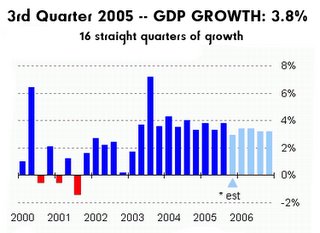
The economy’s 3.8% third-quarter growth (subject to revision in the coming months) was remarkable, given the storms that occurred during almost the entire final month of the quarter:Economists had forecast GDP would advance at a 3.6% rate in the July-to-September quarter. The economy has now expanded faster than 3% for 10 straight quarters.
So when was the last time the economy expanded faster than 3% for 10 straight quarters?
It didn’t happen during the 1990s (the longest streak was eight).
It last happened during the 13 quarters from 1Q 1983 through 1Q 1986. Not coincidentally, a president who believed in lowering taxes to stimulate economic growth was in charge the last time it happened.
So despite being at war, despite devastating storms, and despite legislative and regulatory drags on the economy like Sarbanes-Oxley, this has been most consistently growing economy in almost 20 years.
Not only that, the US economy has NEVER had a streak of more than 7 quarters of 3.0% or greater annualized growth at any other time in the 58 years that quarterly GDP statistics have been kept!
HT to Willisms, a great site for figures behind the news.
20051028
Candide
In today's WSJ Science Journal article by Sharon Begley. Is it all just foolish optimism manifested by rationalization?
Our Brains Strive To See Only the Good, Leading Some to God
October 28, 2005; Page B1
Life is full of surprises, but it's rare to reach for a carafe of wine and find your hand clutching a bottle of milk -- and even rarer, you'd think, to react by deciding the milk was actually what you wanted all along.
Yet something like that happened when scientists in Sweden asked people to choose which of two women's photos they found most attractive. After the subject made his choice, whom we'll call Beth, the experimenter turned the chosen photo face down. Sliding it across the table, he asked the subject the reasons he chose the photo he did. But the experimenter was a sleight-of-hand artist. A copy of the unchosen photo, "Grizelda," was tucked behind Beth's, so what he actually slid was the duplicate of Grizelda, palming Beth.
Few subjects batted an eye. Looking at the unchosen Grizelda, they smoothly explained why they had chosen her ("She was smiling," "she looks hot"), even though they hadn't.
In 1966, Time magazine asked, "Is God Dead?" Even then, the answer was no, and with the rise of religion in the public square, the question now seems ludicrous. In one of those strange-bedfellows things, it is science that is shedding light on why belief in God will never die, at least until humans evolve very different brains, brains that don't (as they did with Beth and Grizelda) interpret unexpected and even unwanted outcomes as being for the best.
"Belief in God," says Daniel Gilbert, professor of psychology at Harvard University, "is compelled by the way our brains work."
As shown in the Grizelda-and-Beth study, by scientists at Lund University and published this month in Science, brains have a remarkable talent for reframing suboptimal outcomes to see setbacks in the best possible light. You can see it when high-school seniors decide that colleges that rejected them really weren't much good, come to think of it.
You can see it, too, in experiments where Prof. Gilbert and colleagues told female volunteers they would be working on a task that required them to have a likeable, trustworthy partner. They would get a partner randomly, by blindly choosing one of four folders, each containing a biography of a potential teammate. Unknown to the volunteers, each folder contained the same bio, describing an unlikable, untrustworthy person.
The volunteers were unfazed. Reading the randomly chosen bio, they interpreted even negatives as positives. "She doesn't like people" made them think of her as "exceptionally discerning." And when they read different bios, they concluded their partner was hands-down superior. "Their brains found the most rewarding view of their circumstances," says Prof. Gilbert.
The experimenter then told the volunteer that although she thought she was choosing a folder at random, in fact the experimenter had given her a subliminal message so she would pick the best possible partner. The volunteers later said they believed this lie, agreeing that the subliminal message had led them to the best folder. Having thought themselves into believing they had chosen the best teammate, they needed an explanation for their good fortune and experienced what Prof. Gilbert calls the illusion of external agency.
"People don't know how good they are at finding something desirable in almost any outcome," he says. "So when there is a good outcome, they're surprised, and they conclude that someone else has engineered their fate" -- a lab's subliminal message or, in real life, God.
Religion used to be ascribed to a wish to escape mortality by invoking an afterlife or to feel less alone in the world. Now, some anthropologists and psychologists suspect that religious belief is what Pascal Boyer of Washington University, St. Louis, calls in a 2003 paper "a predictable by-product of ordinary cognitive function."
One of those functions is the ability to imagine what Prof. Boyer calls "nonphysically present agents." We do this all the time when we recall the past or project the future, or imagine "what if" scenarios involving others. It's not a big leap for those same brain mechanisms to imagine spirits and gods as real.
Another God-producing brain quirk is that although many things can be viewed in multiple ways, the mind settles on the most rewarding. Take the Necker cube, the line drawing that shifts orientation as you stare at it. If you reward someone for seeing the cube one way, however, his brain starts seeing it that way only. The cube stops flipping.
There are only two ways to see a Necker cube, but loads of ways to see a hurricane or a recovery from illness. The brain "tends to search for and hold onto the most rewarding view of events, much as it does of objects," Prof. Gilbert writes on the Web site Edge. It is much more rewarding to attribute death to God's will, and to see in disasters hints of the hand of God.
Prof. Gilbert once asked a religious colleague how he felt about helping to discover that people can misattribute the products of their own minds to acts of God. The reply: "I feel fine. God doesn't want us to confuse our miracles with his."
20051027
Work in Peace Harriet Miers
Harriet has withdrew her nomination to SCotUS. I am disappointed, not because I am pro-Miers, but because reasonable due process of evaluation was over taken by hysteria. This weakens the executive branch regardless of who is in power.
Bush's statement
Miers' statement
Bush's statement
Today, I have reluctantly accepted Harriet Miers' decision to withdraw her nomination to the Supreme Court of the United States.
I nominated Harriet Miers to the Supreme Court because of her extraordinary legal experience, her character, and her conservative judicial philosophy. Throughout her career, she has gained the respect and admiration of her fellow attorneys. She has earned a reputation for fairness and total integrity. She has been a leader and a pioneer in the American legal profession. She has worked in important positions in state and local government and in the bar. And for the last five years, she has served with distinction and honor in critical positions in the Executive Branch.
I understand and share her concern, however, about the current state of the Supreme Court confirmation process. It is clear that Senators would not be satisfied until they gained access to internal documents concerning advice provided during her tenure at the White House – disclosures that would undermine a President's ability to receive candid counsel. Harriet Miers' decision demonstrates her deep respect for this essential aspect of the Constitutional separation of powers – and confirms my deep respect and admiration for her.
I am grateful for Harriet Miers' friendship and devotion to our country. And I am honored that she will continue to serve our Nation as White House Counsel.
My responsibility to fill this vacancy remains. I will do so in a timely manner.
Miers' statement
Dear Mr. President:
I write to withdraw as a nominee to serve as an Associate Justice on the Supreme Court of the United States. I have been greatly honored and humbled by the confidence that you have shown in me, and have appreciated immensely your support and the support of many others. However, I am concerned that the confirmation process presents a burden for the White House and our staff that is not in the best interest of the country.
As you know, members of the Senate have indicted their intention to seek documents about my service in the White House in order to judge whether to support me. I have been informed repeatedly that in lieu of records, I would be expected to testify about my service in the White House to demonstrate my experience and judicial philosophy. While I believe that my lengthy career provides sufficient evidence for consideration of my nomination, I am convinced the efforts to obtain Executive Branch materials and information will continue.
As I stated in my acceptance remarks in the Oval Office, the strength and independence of our three branches of government are critical to the continued success of this great Nation. Repeatedly in the course of the process of confirmation for nominees for other positions, I have steadfastly maintained that the independence of the Executive Branch be preserved and its confidential documents and information not be released to further a confirmation process. I feel compelled to adhere to this position, especially related to my own nomination. Protection of the prerogatives of the Executive Branch and continued pursuit of my confirmation are in tension. I have decided that seeking my confirmation should yield.
I share your commitment to appointing judges with a conservative judicial philosophy, and I look forward to continuing to support your efforts to provide the American people judges who will interpret the law, not make it. I am most grateful for the opportunity to have served your Administration and this country.
Most respectfully,
Harriet Ellan Miers
20051025
RIP Rosa Parks

I do have to wonder about the original event, as to whatever happened to the man who had to stand as she sat.
20051023
Predictions 2
Well not doing so well. Texas Tech lost big time to Texas yesterday. While i can detail the errors of Tech special teams and penalty ridden play, a lost is a lost. There is also news from the Washington Times that Bush may withdraw Miers' nomination. This would be a huge mistake imo.
20051021
Predictions
1. Harriet Miers will be supreme court justice
2. Tom Delay will be exonerated.
3. Texas Tech ranked #7 in the BCS will beat Texas on the football field on 10/22/2005.
2. Tom Delay will be exonerated.
3. Texas Tech ranked #7 in the BCS will beat Texas on the football field on 10/22/2005.
20051012
SCotUS Nomination: the bases
Similar to what i previously posted is this analysis from the David Ignatius at the WSJ (Subscription required)
However, i disagree that the moderate republicans are taking potshots. Most of the uproar, if not all, have come from the conservatives.
The bickering over the Miers nomination epitomizes the right's refusal to assume the role of a majoritarian governing party. The awkward fact for conservatives is that the American public doesn't agree with them on abortion rights. A CNN/USA Today/Gallup poll in late August found 54% describing themselves as pro-choice, and only 38% as pro-life, roughly the same percentages as a decade ago.
That's the political reality that Mr. Bush has been trying to finesse with his nominations of John Roberts and Ms. Miers. That's why he said in the 2000 primary campaign that he wouldn't impose any litmus test (when other Republicans were demanding one) and would instead focus on a nominee's character and judicial philosophy. The realist in Mr. Bush understands that he can't easily force a nominee who is openly anti-abortion on a country where a solid majority disagrees.
Mr. Bush has been successful when he has connected with the American center. Political scientist Gary C. Jacobson notes that after Sept. 11, 2001, Mr. Bush "enjoyed the longest stretch of approval ratings above 60% of any president in 40 years." In that post-9/11 period, when Mr. Bush was fulfilling his campaign promise to be "a uniter, not a divider," his approval rating among Democrats soared to an astounding 81%.
Mr. Bush and the Republicans had a chance after 2004 to become the country's natural governing party. They controlled the White House and both houses of Congress. The Democrats were in utter disarray, leaderless and idea-less. When Mr. Bush took the podium in January to deliver his soaring second inaugural address, the future seemed to belong to the Republicans.
Mr. Bush squandered this opportunity by falling into the trap that has snared the modern GOP -- of playing to the base rather than to the nation. The Republicans behave as if the country agrees with them on issues, when that demonstrably isn't so. The country doesn't agree about Social Security, doesn't agree about the ethical issues that were dramatized by the torment of Terri Schiavo, doesn't agree about abortion. Yet in a spirit of blind partisanship, House Speaker Dennis Hastert could announce last year that bills would reach the floor only if "the majority of the majority" supported them. That notion of governing from the hard right was a recipe for failure.
What you sense now, as conservative and moderate Republicans alike take potshots at their president, is that the GOP is entering the post-Bush era. A war of succession has begun, cloaked in a war of principles. The cruelest aspect of Mr. Bush's predicament is that the conservatives are treating him with the same disdain they showed his father. What a denouement to the West Wing Oedipal drama: A son who did everything he could to avoid his father's humiliation by the conservative wing of the party is now under attack by the right himself.
Principles are a fine thing, but a narrow, partisan definition of principle has led the Republicans to a dead end. Their inability to transcend their base and speak to the country as a whole is now painfully obvious. Like the Democrats in their years of decline, they are screaming at each other -- not realizing how far they have drifted from the mid-channel markers that have always led to open waters and defined success in American politics.
However, i disagree that the moderate republicans are taking potshots. Most of the uproar, if not all, have come from the conservatives.
20051010
SCotUS Nominations
The difference between 2000 and 2004 election are the "911 republicans" who gave Bush a majority in 2004. 911 republicans care about waging and winning the global war against islamofascism. They are made up of moderate republicans, true liberals (who believe in freedom and democracy for all), and similarly minded independents. True conservatives probably don't care all that much for the war and would as soon see the US isolationist. Most conservatives tolerated it as a necessity, and because it was the right thing to do. But it is not a core tennet of the conservative agenda. Many conservatives have even come out against the war.
When it comes to social issues, the conservatives really want someone who will pass their litmus test for SCotUS (like overturning Roe vs. Wade). Sure they talk about not legislating from the bench, but this is as long as it serves the conservative agenda. I do believe the conservatives are generally less ideologically blinded than their mirrors on the left, but not by much.
Naturally conservatives, being the core supporters of Bush, feel betrayed with the Miers nomination. But it was the 911 republicans that won the 2004 election for Bush. It was the moderates that came out for fighting against islamofascist in the name of security that put him over the top. It will be tacking too far right that will lose seats for the Republicans in the next elections. Thus Bush went for vanilla conservative with Roberts, and stealth moderate-conservative with Miers, to appease the right without alienating the middle. And chances are, he also realize he will likely nominate a 3rd candidate for SCotUS before the end of his tenure. With sufficient republican gains in congress to avoid a filibuster, he will then nominate a "true" conservative. He will no longer worry about the nest election. By the 2008 election, a new face will arrive to recruit votes from the moderate base for the republicans. The SCotUS will be a done deal by then and unlikely to be an election issue.
By being too vocal against Miers the conservatives will likely fracture the Republican electoral base and the democrats will be emboldened. If the Republicans lose seats in congress in 2006 they will be even weaker to manage the threat of filibuster. That will cost them the 3rd nomination. Even worse if the next president is a democrat, who will then likely nominate at least one to SCotUS. Politics is a game of tactics. You have to look 2 moves ahead to win.
A related article at Opinion Journal
When it comes to social issues, the conservatives really want someone who will pass their litmus test for SCotUS (like overturning Roe vs. Wade). Sure they talk about not legislating from the bench, but this is as long as it serves the conservative agenda. I do believe the conservatives are generally less ideologically blinded than their mirrors on the left, but not by much.
Naturally conservatives, being the core supporters of Bush, feel betrayed with the Miers nomination. But it was the 911 republicans that won the 2004 election for Bush. It was the moderates that came out for fighting against islamofascist in the name of security that put him over the top. It will be tacking too far right that will lose seats for the Republicans in the next elections. Thus Bush went for vanilla conservative with Roberts, and stealth moderate-conservative with Miers, to appease the right without alienating the middle. And chances are, he also realize he will likely nominate a 3rd candidate for SCotUS before the end of his tenure. With sufficient republican gains in congress to avoid a filibuster, he will then nominate a "true" conservative. He will no longer worry about the nest election. By the 2008 election, a new face will arrive to recruit votes from the moderate base for the republicans. The SCotUS will be a done deal by then and unlikely to be an election issue.
By being too vocal against Miers the conservatives will likely fracture the Republican electoral base and the democrats will be emboldened. If the Republicans lose seats in congress in 2006 they will be even weaker to manage the threat of filibuster. That will cost them the 3rd nomination. Even worse if the next president is a democrat, who will then likely nominate at least one to SCotUS. Politics is a game of tactics. You have to look 2 moves ahead to win.
A related article at Opinion Journal
20051008
Media Mole Hill
Interesting that whatever the media first report, most seems to be inaccurate the further you delve into it. The latest was the "racist" comment by "Bill Bennett." Thus this should come as no surprise.
If i was into conspiracy theories, i would suggest this last was the foreseen, if not the intended, consequence.
For those who missed the first round of stories, Bennett took a call from a listener who suggested that Social Security might not be in financial difficulty were it not for the millions of abortions that have occurred in recent decades (because, presumably, more young people would be paying into the trust fund). Bennett responded that arguing for or against abortion based on such consequentialist considerations was dangerous because it "cuts both [ways]": "If you wanted to reduce crime, you could -- if that were your sole purpose -- you could abort every black baby in this country, and your crime rate would go down. That would be an impossible, ridiculous, and morally reprehensible thing to do, but your crime rate would go down. So these far-out, these far-reaching, extensive extrapolations are, I think, tricky."
Let us walk, slowly and carefully, through this minefield and see what it shows.
FIRST, IT SHOWS how superficial American political discourse has become -- in several different ways. Bennett was trying to demonstrate to the caller, albeit clumsily, the error of judging the morality of a practice based on the results of the practice.
The caller suggested abortion was bad because it led to bad consequences (i.e., inadequate contributions to the Social Security trust fund). Bennett provided a counter-example: lower crime. If we say abortion is bad because it reduces Social Security contributions, then should we say it is good if it reduces crime? Bennett was attempting to show that arguing backward from consequences can lead to "impossible, ridiculous, and morally reprehensible" positions. The utilitarian calculus of consequentialist ethics involves no regard for important but not easily quantifiable values, such as individual rights and the inherent dignity of every human being.
Stupidly, Bennett clouded the debate by bringing race into the conversation. But because he did bring race into the discussion, a couple of other points bear noting.
The first is a simple mathematical fact: African-Americans commit more crimes, per capita, than whites (though not more crimes in the aggregate). The principal victims of African-American criminals are also African-American. In Richmond in 2002, for instance, 63 of the city's 84 homicide victims were black males. That year a black male in Richmond between 18 and 34 had a higher chance of dying by violence than an African-American serviceman fighting in Iraq; statistically, he was more than twice as likely to die by violence here than in the war zone. This went unremarked by Bennett's critics. But failing to face up to the facts does no good to anyone, least of all to the young men who confront such depressingly awful odds.
HERE IS another point: African-Americans make up 13 percent of the U.S. population, but they have 32 percent of the abortions. More than 12 million black children have been aborted since the 1973 ruling in Roe v. Wade. Of the roughly 1 million abortions that will occur this year, about a third will end the life of a black baby.
If i was into conspiracy theories, i would suggest this last was the foreseen, if not the intended, consequence.
20051005
Historical Revision at the UN
From today's Opinion Journal an interesting tibit brought to you by Claudia Rosett, our favorite observer of the UN.
This year, amid the U.N. festivities over its own 60th birthday and high-minded aims, the General Assembly was even busier than usual. So the U.N. folded Taiwan's request for equitable representation in with a new request sent over by Mr. Hsia, for the U.N. to uphold its own charter by actively promoting peace in the Taiwan Strait--which is lined on the communist side with missiles targeted on Taiwan. Red China, backed by Pakistan, opposed both items. Gambia and Chad argued for Taiwan. The U.N. allotted 24 minutes for the entire debate, and then briskly dismissed it as not worth including in the official agenda of the General Assembly.
Borrowing a page from George Orwell, the U.N. also celebrated its anniversary with a poster in the lobby of its famous but decrepit headquarters, on which it advertised a display of "Original Signatories of the U.N. charter." Except they weren't. The original signatory for China of the U.N. charter was the Republic of China. In the 2005 U.N. version, the signatory listed was "China, People's Republic of." Informed of this Turtle Bay twisting of history, Mr. Hsia wrote to U.N. Undersecretary-General Shashi Tharoor, noting, "It is hard to imagine how the U.N., perhaps the world's most important international organization and one which is widely counted on to preserve the truth, could allow itself to blatantly deviate from history and misinform the world about something so fundamental to its history."
The U.N. did not write back, says Mr. Hsia, nor did the U.N. correct the mistake. Instead, in the finest tradition of Orwell's memory hole--the poster simply vanished.
20051003
Big Government vs Big Brother
In the aftermath of the twin hurricanes and the need for federal spending for reconstruction, two primary issues have arisen. Firstly is the appropriate use of reconstruction funds. There is absolutely no question that the corrupt local governments partially to blame for the disaster in New Orleans, and any other corrupt politicians are kept away from access to reconstruction, at least without tight oversight and review.
The second issue is what should be the role of the federal government. Within this discussion are two aspects of the same dilemma. The two aspects are the size of the government's response and the intrusiveness of the government's response; this is the fundamental question. Is there a difference between big government (size of government) and intrusive government (big brother)? Certainly. A big government if often time necessary to maintain for the national defense, maintain uniform standards across the states, and provide the social safety net in times of peace and time of crisis, as well as protect the framework of law as guaranteed by the constitution. To do this oftentimes necessitates a large budget. This does not mean the federal government should be fiscally irresponsible. Does having a large budget means control of the purse translate to control of action? No. For example, congress is responsible for the budget but congress hardly qualifies as an intrusive big brother.
Big brother is a government ever present daily awareness of what you can do and what you cannot do. The key is the intrusive nature in everyday life.
I think it is inevitable that Government gets big, and this is OK. What is unacceptable is for Government to become intrusive and burdensome to its citizenry, i.e. become big brother.
The second issue is what should be the role of the federal government. Within this discussion are two aspects of the same dilemma. The two aspects are the size of the government's response and the intrusiveness of the government's response; this is the fundamental question. Is there a difference between big government (size of government) and intrusive government (big brother)? Certainly. A big government if often time necessary to maintain for the national defense, maintain uniform standards across the states, and provide the social safety net in times of peace and time of crisis, as well as protect the framework of law as guaranteed by the constitution. To do this oftentimes necessitates a large budget. This does not mean the federal government should be fiscally irresponsible. Does having a large budget means control of the purse translate to control of action? No. For example, congress is responsible for the budget but congress hardly qualifies as an intrusive big brother.
Big brother is a government ever present daily awareness of what you can do and what you cannot do. The key is the intrusive nature in everyday life.
I think it is inevitable that Government gets big, and this is OK. What is unacceptable is for Government to become intrusive and burdensome to its citizenry, i.e. become big brother.
Politic Test
So based on the test, I am categorized as:
55% Socially Moderate
55% Economically Moderate
This places me as a Democrat and Blue.
Ha Ha Ha.
55% Socially Moderate
55% Economically Moderate
This places me as a Democrat and Blue.
Ha Ha Ha.
20050926
Media's Complicity
I have nothing in particular against Al Jazeera any more than any other media organization that seeks to present falsehood and their own political agenda. But this bit of news is interesting in unmasking the complicity of the reporters in terrorism.
Meanwhile in the US, Reports of anarchy at Superdome overstated:
More at Michelle Malkin and Powerline.
The Spanish court also found al Jazeera television reporter Taysir Alony guilty of collaboration with al Qaeda and sentenced him to seven years in jail. Alony was not charged in connection with 9/11.
Yarkas, Alony and the 22 other defendants were expressionless Monday as the verdicts were read out in Spain's National Court at the conclusion of Europe's biggest trial of al Qaeda suspects.
The Syrian-born Alony, 50, was probably the best known of the defendants due to his interview with Osama bin Laden shortly after 9/11.
Prosecutors said Alony carried funds for al Qaeda. Alony professed his innocence in court.
Meanwhile in the US, Reports of anarchy at Superdome overstated:
NEW ORLEANS — After five days managing near riots, medical horrors and unspeakable living conditions inside the Superdome, Louisiana National Guard Col. Thomas Beron prepared to hand over the dead to representatives of the Federal Emergency Management Agency.
Following days of internationally reported murders, rapes and gang violence inside the stadium, the doctor from FEMA — Beron doesn't remember his name — came prepared for a grisly scene: He brought a refrigerated 18-wheeler and three doctors to process bodies.
"I've got a report of 200 bodies in the Dome," Beron recalled the doctor saying.
The real total?
Six, Beron said.
Of those, four died of natural causes, one overdosed and another jumped to his death in an apparent suicide, said Beron, who personally oversaw the handoff of bodies from a Dome freezer, where they lay atop melting bags of ice.
State health department officials in charge of body recovery put the official death count at the Dome at 10, but Beron said the other four bodies were found in the street near the Dome, not inside it. Both sources said no one had been murdered inside the stadium.
At the Ernest N. Morial Convention Center, just four bodies have been recovered, despite reports of heaps of dead piled inside the building. Only one of the dead appeared to have been murdered, said health and law-enforcement officials.
That the nation's frontline emergency-management officials believed the body count would resemble that of a bloody battle in a war is but one of scores of examples of myths about the Dome and the Convention Center treated as fact by evacuees, the news media and even some of the city's top officials, including the mayor and police superintendent.
The vast majority of reported atrocities committed by evacuees — mass murders, rapes and beatings — have turned out to be false, or at least unsupported by any evidence, according to key military, law-enforcement, medical and civilian officials in positions to know.
More at Michelle Malkin and Powerline.
20050922
Media War
A nice description of the media's role in the international war against terrorism. (HT Crossroad Arabia
Another example of the MSM contribution to the war is here at Belmont Club.
Once upon a time we would confront such collaborators and enablers of our enemies. Now we protect their freedom to destroy us. Thank God their power and influence has waned, and waned much more than they realize. Reminds me of Atlas Shrugged by Ayn Rand.
I felt compelled to respond to news, published on our front page, that a teenager was forced against his will to bomb a Shi'a mosque in Iraq. The attack failed as the young man fled the scene; he later admitted to being forced to carry out this mission after being kidnapped, badly beaten and drugged by terrorists. A US military report confirmed his version of events.
He was not the only one; all terrorists are heavily sedated. They are drugged by a media, which gives credence to false stories, written according to its author’s mood, added to fabricate pictures and selected from an angle that serve the interest of terrorist groups, be it former Baath party members or Islamic extremists.
Another example of the MSM contribution to the war is here at Belmont Club.
Once upon a time we would confront such collaborators and enablers of our enemies. Now we protect their freedom to destroy us. Thank God their power and influence has waned, and waned much more than they realize. Reminds me of Atlas Shrugged by Ayn Rand.
20050920
Rita
Rita is expected to be a category five hurricane when it hits Texas. FEMA has not had sufficient time to be reformed but it does have new leadership. Texas will rely on its current disaster response system as well. This will serve as a test to see how the State of Texas will respond, as well as how the same FEMA with a different head. In essence, it is a test of the current system. I am still uneasy about greater role of the federal government in regional crisis.
20050919
Waging War
Since Vietnam, insurgencies and terrorists have learned a valuable lesson. They know they cannot compete directly with national powers, not just the major power like the US but also mid powers like Europe and Israel. The tactical battle they wage on the ground is not their true front line. For example, lets look at Iraq. (HT Wretchard)
The war as waged in Iraq, what we take to be the frontline, is being won. But this is not where our enemy wages their war to win. The true frontline is right in front of us whenever we turn on the TV to watch the news, or open our newspaper to read it. The enemy has relied on reports of their continued activities as sign of their power, regardless of whether they are being defeated on the field. They rely on the absence of good news reporting. And when necessary, they will fabricate the news and present it to us. Behold the rise of Pallywood as reported by Solomonia:
Due to the instability of an insurgent penetrated area, it is deem unsafe for the MSM to send in their reporters independently, or at all. The solution adopted appears to be either contract with the insurgents (whether the MSM realize this or not) for escort duty, or as subcontractor as translators and camera men, or even as independent contractors for the whole footage. This arrangement makes it possible for whole fabrication of the news as the insurgents would like to protray. And Belmont's Club analysis:
Do not trust the mainstream media. But then what to believe? I suggest we all return to the analysis of intent and motives of the parties involved. Then make a preliminary judgment based on principles of ethics and history. Then consider whether what is being reported is consistent with this backdrop. Certainly there will be lapses of reason and straying from the desired path, all sides are human and all sides will err. But history is not built on news cycle.
Q How is the state of the insurgency different today than when you arrived to start your mission?
COL. BROWN: There's a significant difference from when we got here last October. Last October, we faced a foreign fighter that was very well-trained. I remember watching attacks out -- we had an attack that involved about 60 foreign fighters in a pretty complex ambush. By complex I mean three or four forms of engagement. They'll hit you with an IED, small arms, mortars -- a very complex attack. We saw that regularly in November and December. We also defeated -- in one of those fights, we killed 40 terrorists, and we did not lose anybody, and we defeated them every time they tried to do that against us. We really worked hard and aggressively at getting out. I mean, we conducted some 2,100 cordon and searches, and thousands of aggressive offensive operations -- 18 attacks a day against the insurgents back in that time period. I remember watching an attack and seeing the insurgents move against us, and I had to look and say, gee, are those our guys or their guys because they're moving very well around buildings. Now, that was November and December. What we saw is that that's faded away very quickly, as we captured and killed. And we killed some 550 enemy and captured over 3,000.
And as we got to February and March, we saw a completely different foreign fighter. We've captured Libyans. We've captured Saudi, Yemenis, Algerians. And many of these -- one Libyan that we captured about a month and a half ago -- he was clearly brainwashed. And he was told that, you know, what was going on here and brainwashed to come and be a -- what he thought was -- he was going to be a foreign fighter against this crusade against the Muslim religion. He got here. He saw that was not correct. They told he was going to be a suicide martyr. He said he didn't want to do that. When we happened to capture him, several other foreign fighters and the cell leader that was orchestrating them, he was very happy to talk to us about what he had seen and what they had done.
And very interesting that younger foreign fighter that we're seeing now -- very poorly trained. We would call them more like RPGs for hire. And we believe it's the -- we know that the leadership is severely disrupted. Again, from -- about 25 percent of the attacks were very complex prior to elections, as I described. Now we're down to five percent are complex. And we're at the lowest number of attacks by far over the last three months. And that is -- clearly the foreign network is disrupted. The leadership is severely disrupted. We captured Abu Talha, the number-two al Qaeda leader in the north of Iraq. And right after that we got Abu Bara, Madhi Musa (sp), Abu Zab (sp), the next six leaders that would step up and take over. Nobody's taken over now. It's not a very popular position because if they step up, they get captured or killed. And so they're really disrupted, totally different.
The other thing -- the other huge change is the population. And in a counterinsurgency, of course, the terrorists don't have to -- the people don't have to love them; they just have to remain neutral and not turn them in. And when we got here, the people were intimidated, and they were neutral. Now they are turning them in. We'd like to call it, you know, the terrorists swim in a sea of anonymity, and that sea has been taken away from them.
And for example, when we got here, they could fire mortars, and they did that. Three hundred mortar attacks a month was the average for the six months prior to us getting here. As we got the population more and more on the side of their government and their security forces, as they saw how the terrorists offered no hope for the future and their government did, they started turning these guys in. And in the beginning, a guy would fire a mortar; in a city of 2 million, it's pretty hard to track him down. Well, we've captured over 142 mortar systems, and now the average is six attacks a month in the entire province, from 300 to six.
And just a couple of weeks ago, when they did fire a mortar, the people told what they looked like, what their license plate was. In one case, they knew one of the individuals. The Iraqi army went out, tracked them right down, arrested them, and there you have it -- much different from that prior to elections, when, you know, they wouldn't say anything. It was -- we didn't see anything, and it was very hard to stop this.
So it just shows -- and again, I talked about the number of call- ins, the number of tips on the street, the cooperation of the people. The people have -- are fed up with the terrorist acts. I mean, I -- you know, I was -- witnessed one suicide VBIED that killed innocent women and children, and I've never seen evil like that. And the people -- Iraqi people saw that, and they know -- it's very clear to them that their government wants a brighter future for them, the Iraqi security forces want a brighter future, and the terrorists offer nothing but fear and intimidation and a very poor future.
The war as waged in Iraq, what we take to be the frontline, is being won. But this is not where our enemy wages their war to win. The true frontline is right in front of us whenever we turn on the TV to watch the news, or open our newspaper to read it. The enemy has relied on reports of their continued activities as sign of their power, regardless of whether they are being defeated on the field. They rely on the absence of good news reporting. And when necessary, they will fabricate the news and present it to us. Behold the rise of Pallywood as reported by Solomonia:
Last Thursday evening I attended a presentation given by Boston University Professor Richard Landes. The subject concerned the ways in which the Palestinian Arabs manipulate the foreign media - often with the foreign media's cooperation. The focus of the presentation was, of course, on the Muhammed al Durra hoax, and included large quantities of the unedited video from that day.
I saw Professor Landes give this presentation once before, and reported on it at length last September here: Truth is Essential - "The Mideast Conflict Through the Eyes of the Media" Report. Since that time, the al Durra hoax has begun to become accepted as such in an increasing number of places, and France 2 - the French media outlet primarily responsible for the slander - is very much on the defensive. Landes now has a much-improved and far more professional DVD set-up of his video, and the event was taped for use by CAMERA. I won't bother going into detail here again, you can read my previous piece, as well as CAMERA's extensive al Durra (or al Dura) backgrounder here for a timeline and explanation of the scandal. All the same issues of mainstream media refusing to be critical of Arab claims, holding Israel to a different standard and not being particularly interested in objective truth remain the same.
Due to the instability of an insurgent penetrated area, it is deem unsafe for the MSM to send in their reporters independently, or at all. The solution adopted appears to be either contract with the insurgents (whether the MSM realize this or not) for escort duty, or as subcontractor as translators and camera men, or even as independent contractors for the whole footage. This arrangement makes it possible for whole fabrication of the news as the insurgents would like to protray. And Belmont's Club analysis:
Some may argue that 'the Israelis and the US military are also cooking up stories', but that is beside the point: because the point is that nothing on packaged television can be inherently trusted, and Pallywood demonstrates that. If the 60 Minutes host can dish out fantasy -- as he unambiguously does in this case -- then who else can you trust? The answer in my view, is no one. An earlier post noted the existence of enemy "combined media-arms" teams. Col HR McMaster described their role in the enemy order of battle at Tal-afar in this way: "In each of their cells that they have within the city has a direct action cell of about 100 or so fighters. They have a kidnapping and murder cell; they have a propaganda cell, a mortar cell, a sniper cell -- a very high degree of organization here." Pallywood shows one of those "propaganda cells" at work in front of an Israeli checkpoint, and their product on 60 Minutes. How many products of propaganda cells may you have viewed lately?
Do not trust the mainstream media. But then what to believe? I suggest we all return to the analysis of intent and motives of the parties involved. Then make a preliminary judgment based on principles of ethics and history. Then consider whether what is being reported is consistent with this backdrop. Certainly there will be lapses of reason and straying from the desired path, all sides are human and all sides will err. But history is not built on news cycle.
20050918
United Nation Security Council Reform
Four nations are seeking permanent seats on the UN Security Council. I do not believe these will come with veto power currently held by the US, Russia, China, France, and the United Kingdom. The four aspirants are Japan, India, Brazil, and Germany.
US unveils criteria for aspiring UNSC members
The four are forming a coalition to obtain this change as a block. I believe this is a mistake as the group of four is less likely to garner support as a group rather than as a loose coalition or as individuals. From the Daily Yomiuri:
I do not see the US wanting either Germany or Brazil as permanent members. The US will likely support Japan and India's aspiration, Japan more so than India.
China will likely oppose Japan's ascent, and will be tepid to India. It is unclear at this time where the rest of the veto-empowered members lean.
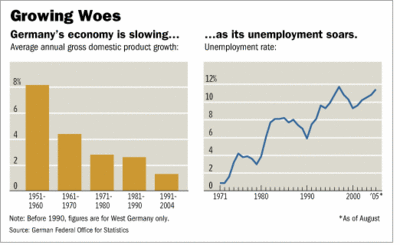
Politics aside, it seems clear that Japan should be a member as the number two economy in the world. Japan's lack of global force presence is by choice, not by lack of ability. This too is being reviewed. Japan would balance that of China in East Asia. India still has a way to go, but India is ascendant. Germany once could have made a claim, but its economic clout has descended to near zero growth. And there are enough Europeans on the council already (France, UK, Russia).
Brazil does not belong; Brazil is stuck in time. Geography and population count are not enough for Brazil. If so, we might as well include Indonesia. At least Indonesia would add Muslim to the mix. Interesting that there are no Middle Eastern power anywhere near any global threshold for consideration.
My thoughts. Japan should be included as a veto capable member of the UNSC.
India should have permanent seat in an expanded UNSC but without veto power.
Germany should not. Brazil should get one when Indonesia, Nigeria, or South Africa get one.
Update: Germany's weekend election will likely result in continued political and economic quagmire.
US unveils criteria for aspiring UNSC members
The state department came out with its vision of UNSC reforms yesterday, saying "potential members must be supremely well qualified, based on factors such as commitment to democracy and human rights, economic size, population, military capacity, financial contributions to the UN, and record on counter-terrorism and non-proliferation".
The four are forming a coalition to obtain this change as a block. I believe this is a mistake as the group of four is less likely to garner support as a group rather than as a loose coalition or as individuals. From the Daily Yomiuri:
a proposal submitted by the so-called Group of Four countries--Japan, Brazil, Germany and India--to increase both the number of permanent and nonpermanent council members was scrapped without being put to a vote.
The group failed to secure support from African nations, which represent a large voting bloc, while permanent council members China and the United States attempted to kill the G-4 plan by any means.
I do not see the US wanting either Germany or Brazil as permanent members. The US will likely support Japan and India's aspiration, Japan more so than India.
‘‘Expansion of the (Security) Council will make it more effective, better than less effective,’’ US Assistant Secretary of State Kristen Silverberg told reporters.
She said for the eligibility of any country, the US considered its commitment to the organization, reflected by financial contributions and contribution to peacekeeping operations.
‘‘We also look at factors like regional diversity, size of the country’s population and size of economy,’’ Silverberg said.
‘‘Japan clearly meets those criteria,’’ she said.
Silverberg, however, said there may be ‘‘other countries’’ meeting the criteria and the US would be ‘‘interested’’ in working with other member countries in this regard.
On Monday, Indian hopes of support for its Security Council bid had risen with the US State Department unveiling its vision of UNSC reforms saying, “factors such as commitment to democracy and human rights, economic size, population, military capacity, financial contributions to the UN and record on counter-terrorism and non-proliferation” would count as qualifications.
China will likely oppose Japan's ascent, and will be tepid to India. It is unclear at this time where the rest of the veto-empowered members lean.
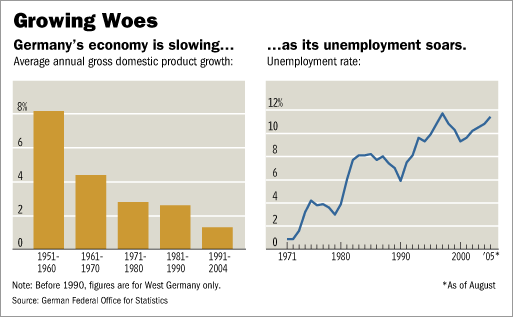
Politics aside, it seems clear that Japan should be a member as the number two economy in the world. Japan's lack of global force presence is by choice, not by lack of ability. This too is being reviewed. Japan would balance that of China in East Asia. India still has a way to go, but India is ascendant. Germany once could have made a claim, but its economic clout has descended to near zero growth. And there are enough Europeans on the council already (France, UK, Russia).
Brazil does not belong; Brazil is stuck in time. Geography and population count are not enough for Brazil. If so, we might as well include Indonesia. At least Indonesia would add Muslim to the mix. Interesting that there are no Middle Eastern power anywhere near any global threshold for consideration.
My thoughts. Japan should be included as a veto capable member of the UNSC.
India should have permanent seat in an expanded UNSC but without veto power.
Germany should not. Brazil should get one when Indonesia, Nigeria, or South Africa get one.
Update: Germany's weekend election will likely result in continued political and economic quagmire.
20050916
the Gulf
The Gulf coast spans from Texas to Florida, with Louisiana, Mississippi and Alabama tucked between. One would think that New Orleans, being smack in the middle of this arc, as well as at the mouth of the Mississippi delta would be the reigning jewel. But it is not is it?
There is much to be said for political policies and corruption influencing, or rather limiting, economic growth. And by economic growth I also mean wealth for the people.
Also interesting are the political leadership of Florida and Texas in the 90s. Care to name names?
In 1831, Alexis de Tocqueville defined a long set of traits that made Americans "different," and that remain today just as valid: Americans are restless, inventive, pragmatic, entrepreneurial, socially mobile, and so future-oriented they are ready and eager sometimes to let go of the past. None of these things defined what once was New Orleans; in fact, that poor destroyed city played them in reverse: It was socially static, fairly caste-ridden, non-entrepreneurial (read hostile to business), and wholly immersed in its past, to the point where its main industry is marketing ambience and nostalgia. "New Orleans's dominant industry lies not in creating its future but selling its past," wrote Joel Kotkin in the Wall Street Journal's OpinionJournal.com. "Tourism defines contemporary New Orleans's economy more than its still-large port, or its remaining industry, or its energy production. Although there is nothing wrong, per se, in being a tourist town, it is not an industry that attracts high-wage jobs; and tends to create a highly bifurcated social structure. This can be seen in New Orleans's perennially high rates of underemployment, crime and poverty." New Orleans, in short, was the place you went to take a vacation, not to prosper in life and start a family, much less start a business. This lack of opportunity, or the upward ladder of social mobility, is perhaps one reason so many evacuees felt they were breathing fresh air when they landed in Houston, and are deciding to make it their home.
Let us look now at Houston, for it is the second city in this cosmic drama, and one in which Tocqueville would feel right at home. Like so many cities in the Sunbelt, it is expanding, entrepreneurial, based on the future, and the place where the "much celebrated American can-do machine that promises to bring freedom and prosperity to less fortunate people" comes roaring to life. "In l920, New Orleans's population was nearly three times that of Houston," says Kotkin. "During the '90s, the Miami and Houston areas grew almost six times as fast as greater New Orleans, and flourished as major destinations for immigrants . . . These newcomers have helped transform Miami and Houston into primary centers for trade, investment and services, from finance and accounting to medical care for the entire Caribbean basin. They have started businesses, staffed factories, and become players in civic life."
It is now no surprise that Houston is the place where in days they built a new city in and around the Astrodome, that has taken in 25,000 refugees from New Orleans, and is planning to feed, house, employ, and relocate most of them. Houston is the place where the heads of all the religious groups in the city--Baptists and Catholics, Muslims and Jews--came together to raise $4.4 million to feed the evacuees for 30 days, and to supply 720 volunteers a day to prepare and serve meals. If New Orleans was where the Third World broke through, Houston was where the First World began beating it back, and asserting its primacy. Are we surprised that the star of this show has been Texas, home of Karl Rove and both Bushes, widely despised by the glitterati as sub-literate, biased, oppressive, and retrograde?
There is much to be said for political policies and corruption influencing, or rather limiting, economic growth. And by economic growth I also mean wealth for the people.
Also interesting are the political leadership of Florida and Texas in the 90s. Care to name names?
20050915
Rebuilding the 3rd Coast
Just listened to President's W Bush speech on Katrina. I have a few thoughts.
1. The economic redevelopment plan for Alabama, Louisiana, and Mississippi could transform and propel three of the nation's poorest states into mainstream standings. I don't think anyone who has not lived in any of these three states can appreciate the significance of this second "reconstruction."
2. Looks like the federal government will assume a greater planning and interventional role for all national disasters. I have mixed feelings about this. I suppose the federal government could require a mandatory emergency plan for all major cities, one that meets a minimum standard in accordance with federal requirements. Once approved and a copy stored centrally, then the local and state governments can take the lead role in determining when the feds are called.
3. A very ambitious speech overall, I think it will be well received by Americans. And as reported by ABC News.
1. The economic redevelopment plan for Alabama, Louisiana, and Mississippi could transform and propel three of the nation's poorest states into mainstream standings. I don't think anyone who has not lived in any of these three states can appreciate the significance of this second "reconstruction."
2. Looks like the federal government will assume a greater planning and interventional role for all national disasters. I have mixed feelings about this. I suppose the federal government could require a mandatory emergency plan for all major cities, one that meets a minimum standard in accordance with federal requirements. Once approved and a copy stored centrally, then the local and state governments can take the lead role in determining when the feds are called.
3. A very ambitious speech overall, I think it will be well received by Americans. And as reported by ABC News.
20050914
America's Allies
In addition:
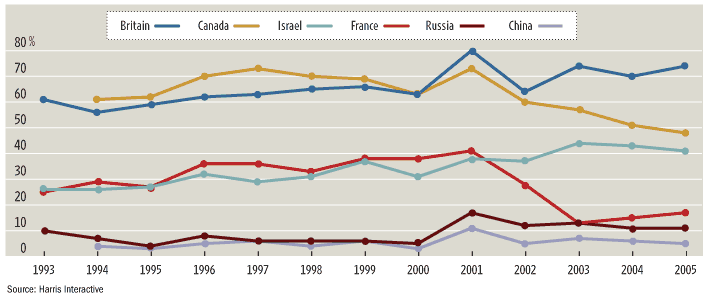
Do you feel that ______ is a close ally of the U.S., is friendly but not a close ally, is not friendly but not an enemy, or is unfriendly and is an enemy of the U.S.?"
Rank Close Ally/Friendly---Rank in: 2003/Rank in: 2004
1 Great Britain 74%/18%---1/1
2 Canada 48/37---2/2
3 Australia 44/36---3/3
4 Israel 41/31---4/4
5 Japan 30/37---6/5
6 Mexico 27/47---5/6
7 Italy 26/43---6/7
8 South Korea 25/31---9/8
9 Germany 24/46---14/10
10 Sweden 23/44---12/12
Others of note
11 Spain 22/43---8/9
+12 Netherlands 21/41---10/10
+12 Taiwan 21/38---12/12
14 India 20/42---21/17
15 Norway 18/41---11/14
16 France 17/38---18/17
17 Greece 16/44---16/15
18 Brazil 14/38---14/17
+19 Russia 11/45---18/20
+19 South Africa 11/42---18/15
+19 Chile 11/35---22/22
+22 Colombia 10/33---22/24
+22 Argentina 10/38---17/20
24 Pakistan 9/24---22/22
25 China 5/36---25/25
Personal notes:
1. France was never that high
2. India has risen fairly fast
3. Where is Poland?
20050912
Looting and Liberty
Sure I have known about looting, but I never really gave it much thought. When Baghdad was liberated, it entered my mind and was assigned a seat in the waiting room. When I came to re-evaluate it, it was in the context of whether Iraqis are ready and capable of democracy. After all, at the first opportunity for free actions, they chose looting as self-expression of liberty. I know that the looting was over played in the media, but that it did occur was clearly demonstrable.
Now looting has re-entered my waiting room due to Katrina. At first I did not recognize it, for we were in a different country with a different people. And without a doubt it needed to be stopped. Even here civilization is a thin veneer. Which then made me realize that if we live that close to chaos here in the States, yet still are able to function as a democratic society, then certainly the Iraqi can as well. Funny enough, this made me feel a bit more certain that democratization of the Middle East can be successful.
As an aside, when the Kobe earthquake left many people homeless, order and respect appear natural to the Japanese. No looting was reported.
Speaking of Japan, congratulations to Koizumi and his reform platform electoral endorsement!
Now looting has re-entered my waiting room due to Katrina. At first I did not recognize it, for we were in a different country with a different people. And without a doubt it needed to be stopped. Even here civilization is a thin veneer. Which then made me realize that if we live that close to chaos here in the States, yet still are able to function as a democratic society, then certainly the Iraqi can as well. Funny enough, this made me feel a bit more certain that democratization of the Middle East can be successful.
As an aside, when the Kobe earthquake left many people homeless, order and respect appear natural to the Japanese. No looting was reported.
Speaking of Japan, congratulations to Koizumi and his reform platform electoral endorsement!
20050909
Katrina: State and the Feds
As witness by the response to Katrina, there needs to be a review not of blame but how things can be done better the next time. The state alone cannot be expected to handle such crisis and there is where the federal government should enter the picture. The question is how the feds enter the equation, at the call of the local/state government who best know the terrain devastated, or should the feds intervene as it sees fit. This last option seems rather presumptuous (having the available resources does not mean having the knowledge necessary to act) and smacks of big government and big brother.
A nice companion piece of the capability of the feds by Daniel Hanninger:
And the limitation of the local/state government by Adrienne McPhail:
A nice companion piece of the capability of the feds by Daniel Hanninger:
The popular impression left the past week-- that the government was wholly unprepared for Katrina--is not true. Significant U.S. military assistance was on alert throughout the week prior to Katrina's landfall. Why those highly trained and drilled assets did not move into New Orleans sooner is a question that should now sit at the center of a debate over who should have the authority--the states or the federal government--to be the "first mover."
According to accounts provided by several sources involved with preparations for Katrina, the Pentagon began tracking the storm when it was still just a number in the ocean on Aug. 23, some five days before landfall in Buras, La. As the storm approached, senior Pentagon officials told staff to conduct an inventory of resources available should it grow into a severe hurricane. Their template for these plans was the assistance DoD provided Florida last year for its four hurricanes.
And a week earlier than this, Defense Secretary Donald Rumsfeld issued an executive order delegating hurricane decision authority to the head of the Northern Command, Adm. Timothy J. Keating. Four days later, as the tropical storm soon to be named Katrina gathered force, Adm. Keating acted on that order.
Before the hurricane arrived in New Orleans, Adm. Keating approved the use of the bases in Meridien, Miss., and Barksdale, La., to position emergency meals and some medical equipment; eventually the number of emergency-use bases grew to six. And before landfall, Adm. Keating sent military officers to Mississippi and Louisiana to set up traditional coordination with their counterparts from the Federal Emergency Management Agency. As well, Deputy Defense Secretary Gordon England ordered the movement of ships into the Gulf.
By the Pentagon's account, it carried out these preparations without any formal Katrina-related request from FEMA or other authorities. The personnel behind the massive military effort now on display in Louisiana--airlift evacuation, medical, supply, and the National Guard--was on alert a week before the hurricane. According to Assistant Secretary McHale, "The U.S. military has never deployed a larger, better-resourced civil support capability so rapidly in the history of our country."
So where were they on the two days of globally televised horror? Why, for instance, didn't DoD fly all this help close to New Orleans as soon as it saw Katrina coming? The answer, in military argot, is that you don't deploy troops beneath a bombing run; Katrina predictably would have wiped out any help put in her uncertain path, just as she rolled over the Big Easy's wholly unprotected "first responders."
Then there's American history, tradition and law. Once disaster arrives, several federal laws designed to protect state sovereignty from being swept aside by a Latin-American-style national police force dictate that a state's officials, specifically the governor, is supposed to phone the federal government and describe what they need. If asked by Homeland Security, DoD will send in the cavalry. But this is one audible at the line even Don Rumsfeld doesn't get to call.
And the limitation of the local/state government by Adrienne McPhail:
Once home to 500,000 people, with more than one-fourth living in poverty, New Orleans the city and Louisiana the state, failed their people long before the rains and winds of Hurricane Katrina tore through their state.
The murder rate in New Orleans is 10 times the national average. To test the response of the poor living in their numerous projects, last year researchers had police fire 700 blank rounds in a city neighborhood one afternoon. No one called to report the gunfire.
The city’s school system went broke this past year, as they were unable to pay their teachers. Meanwhile, dozens of school employees are under indictment for corruption.
Fifty-five of the state’s 78worst schools are in New Orleans. Mayor of New Orleans Ray Nagin was once the general manager for Cox Communications in southeast Louisiana. Prior to holding this position he had no experience in public office.
While there will be plenty of blame to go around in this tragedy, there can be no denying that the first line of defense in such disasters is the mayor, then the governor, then the federal agencies. The US Army Corps of Engineers have been building levees along the Mississippi River since the late 1800s and it was no secret in New Orleans that they were not built to withstand anything stronger than a Category 3 storm.
20050908
Battle for the Border
There is currently a combined US and Iraqi military offensive to clear the border of western Iraq with Syria. Not surprisingly there is little to no mention of it in the mainstream media. I guess in order to maintain the illusion that Iraq is Vietnam, the US military cannot be portrayed as taking any initiative for offense. Better maintain the charade that US soldiers are just hapless victims. But you can say no thanks to the MSM and reading the Fourth Rail.
20050905
Katrina
A week has passed since Katrina hit the gulf coast. Plenty has already been written on it. Some are simply ridiculous in assigning blame to W Bush and or global warming. These are pathetic and their refutations are readily available elsewhere. In addition, the contest for political control of rescue effort between local/state politicians and the federal government in Louisiana is also pathetic. Take this story about medical relief. This situation must be resolved as a similar crisis can be a result not of a natural disaster but from possible terrorism attack. Finally, with all the attention going toward human rescue, lets also remember others needs rescue as well.
General contacts can be found here including for Lousianna SPCA.
Best wishes for the victims all.
General contacts can be found here including for Lousianna SPCA.
Best wishes for the victims all.
20050817
Soldier's Morality
From today's WSJ on an important but rarely discussed topic.
Perhaps the importance of this topic is not the topic itself, but that the topic be discussed by those most intimate with it.
War Wounds
Breaking a Taboo, Army Confronts Guilt After Combat
West Point Professor Pushes Military to Talk to Troops About Battlefield Killing
A 'Blood Curdling' Sound
By GREG JAFFE
Staff Reporter of THE WALL STREET JOURNAL
August 17, 2005; Page A1
Not long ago Maj. Peter Kilner posted on an Army-sponsored Web site a short essay he had written on the morality of killing in combat.
The topic had long fascinated the West Point philosophy and ethics professor. Outside of the pacifist movement, though, no one had shown much interest in his work on the subject. This time the response from his fellow officers surprised him.
One officer emailed him about his experience after opening fire on a car fleeing a U.S. Army roadblock in Iraq. "What I'll never forget about that engagement was listening to the family react when they saw the inside of the car and their loved one without a chest," the officer wrote. "I know what I did was right. But I'll never lose the sound of that grief-stricken family." The sound was "blood curdling," he added in a later email to a reporter.
Slowly, Maj. Kilner's writings -- which encourage officers to talk to their troops about the morality of killing in combat and the guilt that often comes with taking another's life -- have begun gathering a wide audience.
Instructors at a military-police school in Missouri have passed them around to spur discussions on the morality of killing. At the Army's school for newly minted chaplains in South Carolina, Maj. Kilner's writings are being incorporated into a new course to be offered later this year on how to counsel soldiers on the morality of war. Recently a battalion of troops from the 101st Airborne Division gathered to discuss his theories on killing prior to deploying to Iraq later this fall.
"Until recently I have never seen anyone address a group about their feelings on killing," says Maj. Kilner. "It is just impolite conversation...like asking someone have you had an abortion?"
Four years of heavy combat, however, are slowly altering the way the Army talks about this long-taboo subject. It's a shift that Maj. Kilner, along with other Army officers and military psychiatrists, say is long overdue.
Drawing from a wide body of philosophy, Maj. Kilner argues that killing is morally acceptable when the enemy poses a threat to values worth fighting for, such as life or liberty, and there are no nonlethal options to avoid the threat. Shades of the same argument have been used for centuries by rulers and soldiers to justify killing on the battlefield.
Maj. Kilner is pushing America's current crop of Army officers to help their soldiers confront the morality of killing on a personal level. Failure to address these issues in training, Maj. Kilner argues, can sometimes disable soldiers in combat, and leave them more prone to psychological traumas after the battle is finished.
"My goal is to break the taboo. Let's start talking and see what develops," Maj. Kilner says.
The U.S. military's views on how to equip soldiers to kill grew out of work by Brig. Gen. S.L.A. Marshall during World War II. Gen. Marshall determined that fewer than 25% of U.S. riflemen in combat fired their weapons.
"Fear of killing rather than fear of being killed was the most common cause of battle failure," he wrote. Critics have since raised questions about the reliability of Gen. Marshall's data, but the premise of the report -- that many soldiers balked at pulling the trigger -- has been widely accepted.
To overcome this resistance the Army began training soldiers on lifelike pop-up targets that more closely resembled what they would see in actual combat. Soldiers repeat the same drills until their reactions become second nature.
The training has worked. By Vietnam 90% of soldiers fired their weapons. Maj. Kilner, who went to Iraq as part of a team writing the official Army history of the war, recalls interviewing a soldier in Kirkuk who had been walking a patrol when a sniper's shot grazed his uniform.
"The soldier heard the round, turned and fired two shots into the enemy sniper's chest and kept walking just like he would have on the range. His company commander was so proud," says Maj. Kilner.
Such reflexive training is good because it keeps soldiers alive, Maj. Kilner says. But it can also cause problems. "When military training has effectively undermined soldiers' moral autonomy they morally deliberate their actions only after the fact," he wrote in a 2002 article in Military Review, a U.S. Army military journal.
Soldiers who can't justify their actions will be more likely to suffer crippling guilt, nightmares and post-traumatic stress, he suggested.
To help soldiers, commanders must let soldiers who are carrying out lawful orders know that feelings of guilt after combat are natural and not "a sign of moral culpability or mental weakness," he says.
Maj. Kilner, 39 years old, became interested in killing and combat stress at a time when the Army was giving it little thought. He hasn't seen combat himself, but he served as an infantry officer in the 82nd Airborne Division. Afterward, the Army sent him to Virginia Tech in the mid-1990s to get a graduate degree in philosophy. Looking for an area of study that would be relevant when he returned to teach at West Point, he decided to explore the moral justification for killing in combat.
He immersed himself in the philosophical literature of war. "After a few months I was a good pacifist wondering if I could continue my army career," he says. Searching for answers, he decided to conduct some research and took out a small advertisement in a U.S. Army professional journal. "If you have killed in combat and you feel justified please send me your comments. I'd like to talk with you," he wrote. The responses ran the gamut. One World War II veteran sent him page after page of Biblical verses. Some veterans sent long, detailed accounts of their own experiences with killing. He also got some "absolute hate mail," he says. A retired colonel and Vietnam veteran wrote him a two-page letter, which he still has, asking: "Who are you to say that what I did was wrong?" The passionate and fevered responses convinced him he was onto something.
He finished his graduate degree in 1998 and went to West Point a few months later. Shortly after 9/11 he penned an essay for Military Review, a U.S. Army professional journal, arguing that "soldiers deserve to understand who they can kill morally and why those actions are moral." In the essay he argued that U.S. soldiers should function as "the last line of defense for the rights of life and liberty" and are "morally obliged" to use lethal force to defend the innocent. U.S. troops must also be willing to assume additional risk to themselves and their subordinates to minimize damage to civilians.
"We must remember our calling: to risk ourselves to protect the innocent," he wrote. The essay drew little attention until the Iraq war. Soldiers began returning home with post-traumatic stress disorder rates comparable to Vietnam. In July 2004 , the New England Journal of Medicine reported that some 17% of returning Iraq veterans suffered from depression, severe anxiety or post-traumatic stress disorder.
Hard evidence linking guilt from killing to post-traumatic stress is limited. One 1999 study concluded that Vietnam veterans who had killed suffered more acute post-traumatic stress symptoms than those who hadn't. The study by Rachel MacNair, a psychologist and pacifist, relied on data from the Congressionally funded National Vietnam Veterans Readjustment Study from the mid-1980s.
Many soldiers, though, say the connection between killing and combat stress is real. Lt. Jonathan Silk, who led a platoon of the 2nd Armored Cavalry Regiment, says that his soldiers were particularly shaken by their first and only big daylight battle. "You could see what weapons did to people. You could see bodies destroyed and torn apart," he says.
During the fight his men were cheering. Just a few hours afterward , Lt. Silk says his gunner was shaking. Another soldier "wouldn't stop talking....There was an emotional crack in his voice," he says.
He asked his commanders to send a team of mental-health counselors to talk to his troops. "My gunner was very focused on the fact that he killed a large number of enemy," Lt. Silk says. In the session with the counselors they talked through why he had to open fire.
Eighteen months later the images from the fight still linger. "I have a constant-playing video of [the battle] in my head," Lt. Silk says. The fight convinced the 36-year-old officer that he needed to talk more with his troops about killing prior to combat. Typically soldiers playing the enemy in training exercises will pop back to life immediately after they are "shot." In the future Lt. Silk says it may be useful to have the dead remain on the ground. Soldiers at the end of the battle would have to explain why they killed and why it was justified.
He also says he will talk more with his troops after combat. "It is great to see the president telling us how just our cause is...But he is not doing the killing with us. Soldiers need to hear it from their immediate leaders, and those leaders need to understand why killing is right," he says today.
Haunted by the Incident
There is no established program or training for commanders who want to talk with their soldiers about killing and its aftermath, leaving soldiers and commanders to cobble together their own solutions. The captain who emailed Maj. Kilner about his reaction to the checkpoint shooting wrote he was so haunted by the incident when he got home that he couldn't fall asleep without downing a six pack of beer.
At the time of the shooting he was overseeing a checkpoint near Fallujah when a car approached and then abruptly tried to flee. He let loose a volley of 28 rounds, tearing off the passenger's chest. "The passenger I killed had a loaded AK-47 on his lap that I didn't see when I first shot," he writes in an email.
After he returned to the U.S. he saw a mental-health counselor, which helped. So did talking to friends. "But a part of it was going to confession and believing that I was placed in the situation by a higher power who knew I made the right decision. Whether I follow these beliefs out of comfort or convenience I guess I won't know the answer until the afterlife," he recently wrote in an email from Iraq, where he is in the midst of his second year-long deployment.
He asked not to be named because he hasn't told his family about his combat experiences. "I am not sure they accept the fact that I am a combat arms officer who doesn't see the sanitized side of war," he added.
A Family's Reaction
Other soldiers say they felt sadness only after they returned to the U.S. Sgt. Darrell Borst, a 22-year-old soldier who fought in Iraq with the 1st Armored Division, wasn't bothered by his combat experience until his aunt asked him at a homecoming party if he had killed anyone. When he answered yes the room fell silent. "My family's reaction really bothered me. There was sadness in their eyes. It still bothers me today," he says. "It is like they remember you in a certain way and now you are different."
Such reactions explain why some officers are trying to figure out how to prepare soldiers before they're ever put in a position to kill. Lt. Col. Eric Conrad, a commander from the 101st Airborne Division whose soldiers recently gathered to discuss Maj. Kilner's writings, worried how his 400-soldier battalion would react to the carnage they were likely to see. None of the soldiers in his unit are front-line combat troops. Instead the unit consists of military police, intelligence soldiers, engineers, truck-drivers and communications specialists.
In a conference room at the division's home in Ft. Campbell, Ky., Capt. Jerry Moon, one of Col. Conrad's unit commanders, passed out copies of Maj. Kilner's essays to all of the officers in the battalion. The next day he asked the group of officers why it was OK to kill.
"If you don't do it over there, they will come over here and do it to your family like the World Trade Center," said Lt. James Stewart. "It is our Constitution or their radical Islam." Other officers cited the brutality with which the insurgents have killed Iraqi and Western hostages, casting them as subhuman psychopaths.
As the officers talked Capt. Moon quietly pulled out a book entitled "Offerings at the Wall," a catalog of mementoes left at the Vietnam Veteran's memorial in Washington. He flipped to a page dominated by a worn photograph of a Vietnamese soldier and his young pigtailed daughter left at the memorial by a U.S. soldier. Then he read aloud the anonymous letter that accompanied it:
"Dear Sir , for 22 years I have carried your picture in my wallet. I was only 18 years old that day we faced one another...Why you didn't take my life I'll never know. You stared at me so long, armed with your AK-47, and yet you did not fire. Forgive me for taking your life. So many times over the years I have stared at your picture and your daughter, I suspect. Each time my heart and guts would burn with the pain of guilt....Forgive me, Sir."
The room fell silent. Lt. Travis Thebeau, a 31-year-old intelligence officer spoke first. "We all go in with the idea that it is us or them. I don't think that will hold up for an 18- or 19-year-old kid. Maybe it holds up when he pulls the trigger. But it won't hold up 10 years down the road," he said.
Capt. Moon suggested that he and his fellow soldiers could find comfort in the knowledge that they "fight for a cause that is morally sound. We extend liberties to people," he said. But even Capt. Moon worried that was not enough. "What if public opinion swings against this war? If the American people don't see this as a just war does that making the killing harder?" he asked. The officers shrugged. Col. Conrad urged his officers to keep the discussion going with their soldiers.
"If you raise the subject here your soldiers are going to know they can come back to you later," he suggested.
Perhaps the importance of this topic is not the topic itself, but that the topic be discussed by those most intimate with it.
20050807
the fantastic four
No, not a movie review. From the Times UK:
Ofcourse Blair is correct that such people should be deported. It would be ridiculous to protect the rights of those who seek to destroy you. Read it all. (HT LGF)
A Sunday Times reporter spent two months as a recruit inside the Saviour Sect to reveal for the first time how the extremist group promotes hatred of “non-believers” and encourages its followers to commit acts of violence including suicide bombings.
The reporter witnessed one of the sect’s leading figures, Sheikh Omar Brooks, telling a young audience, including children, that it was the duty of Muslims to be terrorists and boasting, just days before the July 7 attacks, that he wanted to die as a suicide bomber.
After the attacks that claimed 52 lives, another key figure, Zachariah, justified them by saying that the victims were not “innocent” people because they did not abide by strict Islamic laws. In the immediate aftermath the sect’s leader, Omar Bakri Mohammed, said: “For the past 48 hours I’m very happy.” Two weeks later he referred to the bombers as the “fantastic four”.
. . .
Speaking to a group of teenagers and families, he declared it was imperative for Muslims to “instil terror into the hearts of the kuffar” and added: “I am a terrorist. As a Muslim of course I am a terrorist.”
Ofcourse Blair is correct that such people should be deported. It would be ridiculous to protect the rights of those who seek to destroy you. Read it all. (HT LGF)
20050805
Embers in the East and "no mas" from Africa
Two items of note of late.
Firstly the brewing tension between democratic Poland and authoritarian Belarus by Kamil Tchorek.
Unfortunately, I am skeptical the EU will do much. I first noticed the item at Chrenkoff on July 30th.
Second item is regarding the futility of aide to corrupt government with the delusional hope that somehow their poor and destitute constituents would benefit. Interview at Spiegel
In addition, there are two must read items from Belmont Club.
Firstly the brewing tension between democratic Poland and authoritarian Belarus by Kamil Tchorek.
MINSK -- While western Europe focuses on terrorism in London, the terror state of Belarus, dominated by dictator Alexander Lukashenko, is treated in the tradition of Neville Chamberlain's "faraway country of which we know little."
This is a mistake. Aside from the close though little-known historical and cultural ties that the West has with Belarus -- Tadeusz Kosciuszko, a leading figure in the American Revolution and an early advocate of democracy and emancipation, was born and bred in these parts -- the Moscow-backed regime in Minsk poses a security risk to Europe.
Two years ago Saddam Hussein's closest aide, Abid Hamid Mahmud Tikriti, was captured carrying Belarus passports for himself and Saddam's notorious sons. After a recent state visit from Tehran, the flag of Iran has been left to decorate the main thoroughfare in Minsk. Mr. Lukashenko is arming himself with cutting-edge Sukoyev Su-30s.
Last week, in a chilling echo of the Balkan conflict, Belarus special forces stormed buildings used by the nearly 500,000 strong ethnic Polish community -- some of whom live in the village of Kosciuszko's birth. The woman who leads the Union of Poles, Andzelika Borys, yesterday was questioned by police; her deputy and four other Union activists are in prison. Minsk is trying to replace her with a quisling. In protest, Warsaw last week withdrew its ambassador from Minsk.
Poland, Belarus' western neighbor and the EU's largest new member, is taking a far tougher line with Mr. Lukashenko than much of Europe. Poland has provided refuge for Belarusian émigrés who support the democracy movement, and has allowed the Belarusian opposition to use Warsaw as a place to work with Western NGOs and diplomats, assemble and speak freely without fear of reprisal.
This policy is buoyed by American legislation. Washington's Belarus Democracy Act 2004 grants financial backing to promote human rights and democratic development in Belarus. But as evidenced by a letter from the Polish foreign ministry to European leaders last month, at the start of the crisis, Poland is having to work to get the EU to follow suit.
In private, some EU diplomats emphasize that it is important not to antagonize Russia, an ally of Belarus, and dismissively claim that Poland has an interest in raising its profile through conflict.
But Poland's Eastern policy is set to get tougher still. After elections next month, Poland's ruling ex-communists are likely to be replaced by the conservative opposition. When I recently interviewed a leading candidate for prime minister, Jan Rokita, he spoke of foreign policy in positively neoconservative terms. "This now ends the period of mild politics," he said of the crackdown on the Polish minority. "Ours will be a simple message: Lukashenko must go. I will do all I can to help the Belarus opposition and I will want the EU to engage rather than look the other way."
On Monday, Mr. Rokita's colleague and presidential candidate Donald Tusk crossed into Belarus to show the Polish community there that they aren't alone. Since then, Belarusian Poles who met with Mr. Tusk have been jailed, and one of the prisoners, Andrzej Pisalnik, who edits the Polish-language newspaper, has responded by going on hunger strike.
Meanwhile, also on Monday, an emerging opposition leader, Alexander Milinkevitch was in Poland. "This is not an ethnic minority problem," Mr. Milinkevitch told me. "This is a civil rights problem for all Belarusian people from whatever background. Lukashenko is destroying civic society and we've got to stop him."
Mr. Milinkevitch believes that there is a European tendency to consign the current crisis between Warsaw and Minsk to the realm of bilateral relations. To continue to believe this, he argues, would play into Mr. Lukashenko's hands. His immediate wish is for Europe to rally round Poland in support of democracy in Belarus.
The shared vision of Jan Rokita and Alexander Milinkevitch is rooted in history. From the sixteenth century, Belarus was united with Lithuania, Ukraine and Poland in a state known as the "Rzeczpospolita Polska," or Polish Commonwealth. Much like in the United Kingdom or the U.S., citizens could belong to any or several cultural groups but swear allegiance to one state.
In such traditions tolerance is born. It is no coincidence that European Jews, Armenians and Protestants thrived in the Rzeczpospolita when they were hounded elsewhere. The Rzeczpospolita also produced Europe's first written constitution, which was defended militarily by Kosciuszko, who was born in Belarus of Lithuanian stock, spoke Polish, and was awarded American citizenship.
It is also unsurprising that the Czarist and Soviet empires attempted to rub out this history. "Until perestroika I thought I was Russian, and a minor Russian at that," commented Mr. Milinkevitch. "All my life, like everyone in Belarus and Ukraine, I'd been told that Russian history was our history, and that we didn't have our own. Now that we have learnt about ourselves, we want change."
As a means of coercion, President Lukashenko is doing everything to russify the nation and make sure the historical links with Poland aren't restored. He has changed the national flag from the medieval red and white Belarusian banner it was in the 1990s to a near copy of the Soviet era symbol. He has closed Jewish, Polish and Belarusian schools and established Russian replacements. For years he has touted plans to reunify with Russia, though they've never gone far.
Europe can stand by and watch Belarus, a European country, plunge into a totalitarian abyss. Or it can recognize and support the immense effort of so many Belarusians to become a democracy.
Unfortunately, I am skeptical the EU will do much. I first noticed the item at Chrenkoff on July 30th.
Second item is regarding the futility of aide to corrupt government with the delusional hope that somehow their poor and destitute constituents would benefit. Interview at Spiegel
"For God's Sake, Please Stop the Aid!"
The Kenyan economics expert James Shikwati, 35, says that aid to Africa does more harm than good. The avid proponent of globalization spoke with SPIEGEL about the disastrous effects of Western development policy in Africa, corrupt rulers, and the tendency to overstate the AIDS problem.
In addition, there are two must read items from Belmont Club.
20050722
Islamofascism: First they came for the Jews
By Victor David Hanson:
Read it all. Good parallel.
First the terrorists of the Middle East went after the Israelis. From 1967 we witnessed 40 years of bombers, child murdering, airline hijacking, suicide murdering, and gratuitous shooting. We in the West usually cried crocodile tears, and then came up with all sorts of reasons to allow such Middle Eastern killers a pass.
...
Read it all. Good parallel.
20050715
WoT: Complaints and Rebuttals
Nicely reviewed by victor Davis Hanson
The popular complaints:
The factual responses:
Do read it all.
The popular complaints:
Either we were unfairly tilting toward Israel, or had been unkind to Muslims. Perhaps, as Sen. Patty Murray intoned, we needed to match the good works of bin Laden to capture the hearts and minds of Muslim peoples.
The fable continues that the United States itself was united after the attack even during its preparations to retaliate in Afghanistan. But then George Bush took his eye off the ball. He let bin Laden escape, and worst of all, unilaterally and preemptively, went into secular Iraq — an unnecessary war for oil, hegemony, Israel, or Halliburton, something in Ted Kennedy's words "cooked up in Texas."
In any case, there was no connection between al Qaeda and Saddam, and thus terrorists only arrived in Iraq after we did.
That tale goes on. The Iraqi fiasco is now a hopeless quagmire. The terrorists are paying us back for it in places like London and Madrid.
Still worse, here at home we have lost many of our civil liberties to the Patriot Act and forsaken our values at Guantanamo Bay under the pretext of war. Nancy Pelosi could not understand the continued detentions in Guantanamo since the war in Afghanistan is in her eyes completely finished.
In this fable, we are not safer as a nation. George Bush's policies have increased the terror threat as we saw recently in the London bombing. We have now been at war longer than World War II. We still have no plan to defeat our enemies, and thus must set a timetable to withdraw from Iraq.
Islamic terrorism cannot be defeated militarily nor can democracy be "implanted by force." So it is time to return to seeing the terrorist killing as a criminal justice matter -- a tolerable nuisance addressed by writs and indictments, while we give more money to the Middle East and begin paying attention to the "root causes" of terror.
The factual responses:
Prior to 9/11, the United States had given an aggregate of over $50 billion to Egypt, and had allotted about the same amount of aid to Israel as to its frontline enemies. We had helped to save Muslims in Bosnia, Kosovo, Somalia, Kuwait, and Afghanistan, and received little if any thanks for bombing Christian Europeans to finish in a matter of weeks what all the crack-pot jihadists had not done by flocking to the Balkans in a decade.
Long before Afghanistan and Iraq, bin Laden declared war on America in 1998, citing the U.N. embargo of Iraq and troops in Saudi Arabia; when those were no longer issues, he did not cease, but continued his murdering. He harbored a deep-seated contempt for Western values, even though he was eaten within by uncontrolled envy and felt empowered by years of appeasement after a series of attacks on our embassies, bases, ships, and buildings, both here and abroad.
Iraqi intelligence was involved with the first World Trade Center bombing, and its operatives met on occasion with those who were involved in al Qaeda operations. Every terrorist from Abu Abbas and Abu Nidal to Abdul Yasin and Abu al-Zarqawi found Baghdad the most hospitable place in the Middle East, which explains why a plan to assassinate George Bush Sr. was hatched from such a miasma.
Neither bin Laden nor his lieutenants are poor, but like the Hamas suicide bombers, Mohammed Atta, or the murderer of Daniel Pearl they are usually middle class and educated -- and are more likely to hate the West, it seems, the more they wanted to be part of it. The profile of the London bombers, when known, will prove the same.
The poor in South America or Africa are not murdering civilians in North America or Europe. The jihadists are not bombing Chinese for either their godless secularism or suppression of Muslim minorities. Indeed, bin Laden harbored more hatred for an America that stopped the Balkan holocaust of Muslims than for Slobodan Milosevic who started it.
There was only unity in this country between September 11 and October 6, when a large minority of Americans felt our victim status gave us for a golden moment the high ground. We forget now the furor over hitting back in Afghanistan -- a quagmire in the words of New York Times columnists R. W. Apple and Maureen Dowd; a "terrorist campaign" against Muslims according to Representative Cynthia McKinney; "a silent genocide" in Noam Chomsky's ranting.
Two thirds of al Qaeda's command is now captured or dead; bases in Afghanistan are lost. Saddam's intelligence will not be lending expertise to anyone and the Baghdad government won't welcome in terrorist masterminds.
In fact, thousands of brave Iraqi Muslims are now in a shooting war with wahhabi jihadists who, despite their carnage, are dying in droves as they flock to the Iraq.
A constitution is in place in Iraq; reform is spreading to Lebanon, the Gulf, and Egypt; and autocracies in Saudi Arabia, Libya, and Pakistan are apprehensive over a strange new American democratic zeal. Petroleum was returned to control of the Iraqi people, and the price has skyrocketed to the chagrin of American corporations.
There has been no repeat of September 11 so far. Killing jihadists abroad while arresting their sympathizers here at home has made it hard to replicate another 9/11-like attack.
The Patriot Act was far less intrusive than what Abraham Lincoln (suspension of habeas corpus), Woodrow Wilson (cf. the Espionage and Sedition Acts), or Franklin Roosevelt (forced internment) resorted to during past wars. So far America has suffered in Iraq .006 percent of the combat dead it lost in World War II, while not facing a conventional enemy against which it might turn its traditional technological and logistical advantages.
Unlike Gulf War I and the decade-long Iraqi cold war of embargos, stand-off bombing, and no-fly-zones, the United States has a comprehensive strategy both in the war against terror and to end a decade and a half of Iraqi strife: Kill terrorists abroad, depose theocratic and autocratic regimes that have either warred with the United States or harbored terrorists, and promote democracy to take away grievances that can be manipulated and turned against us.
Do read it all.
20050708
Community vs Individuals
For a healthy and vibrant society to grow, individual rights must be safeguarded. This includes the right to anonymity. But an individual’s rights must not exceed that of the community good and cannot transcend the law.
With regard to the Plame flame games, a law may have been violated, and trust in the government is questioned. The reporters must yield their anonymous sources.
For a healthy and vibrant society to grow, individual rights must be safeguarded. This includes the right to property. The community cannot trample on this right in the name of common good. There can be no common good when individuals are not secure of their possession.
With regard to the recent Kelo ruling by the Supreme Court, it was a travesty. This ruling needs to be revised.
With regard to the Plame flame games, a law may have been violated, and trust in the government is questioned. The reporters must yield their anonymous sources.
For a healthy and vibrant society to grow, individual rights must be safeguarded. This includes the right to property. The community cannot trample on this right in the name of common good. There can be no common good when individuals are not secure of their possession.
With regard to the recent Kelo ruling by the Supreme Court, it was a travesty. This ruling needs to be revised.
20050707
20050706
W in the Times
I've never thought Bush an eloquent speaker. In fact i frequently laugh during his speeches because it sounded funny for some reason. But then i read this interview published in the British Times (HT New Sisyphus).
What struck me, now that i think about it, is that he really does believe what he says. Unlike so many post-modernists (in the aftermath of WW2) who believes that human actions can only cause harm, thus it would be better to suffer (especially better if someone elses does the suffering). W still believes that human actions can do substantial good for humanity. In fact, i now wonder if the reason i find W speechs so goofy at times is because he is almost naive about his faith in humanity. Stark in a world so cynical and crass. Which makes me glad for smiling and laughing at his speech. It is a good thing. I like the W.
THE TIMES: Mr President, last night you mentioned the link between Iraq and 9/11, but there's evidence of Iraq becoming a haven for jihadists, there's been a CIA report which says that Iraq is in danger of... are you at risk of creating kind of more of the problems that actually led directly to...?
PRESIDENT BUSH: No. Quite the contrary. Where you win the war on terror is go to the battlefield and you take them off. And that's what they've done. They've said, Look, let's go fight. This is the place. And that was my point. My point is that there is an ideology of hatred, an ideology that's got a vision of a world where the extremists dictate the lives, dictate to millions of Muslims. They do want to topple governments in the Middle East. They do want us to withdraw. They're interested in exporting violence. After all, look at what happened after September 11 (2001). One way for your readers to understand what their vision is is to think about what life was like under the Taleban in Afghanistan.
So we made a decision to protect ourselves and remove Saddam Hussein. The jihadists made a decision to come into Iraq to fight us. For a reason. They know that if we're successful in Iraq, like we were in Afghanistan, that it'll be a serious blow to their ideology. General (John) Abizaid (Commander of US forces in the Middle East) told me something very early in this campaign I thought was very interesting. Very capable man. He's a Arab-American who I find to be a man of great depth and understanding. When we win in Afghanistan and Iraq, it's a beginning of the end. Talking about the war on terror. If we don't win here, it's the beginning of the beginning. And that's how I view it.
We learnt first-hand the nature of the war on terror on September 11. And last time I went to Europe I said many in Europe viewed September 11 as a tragic moment, but a moment. I view September 11 as an attack as a result of a larger war that changed how I view the world and how many other Americans view the world. It was one of the moments in history that changed outlook. So as long as I'm sitting here in this Oval Office, I will never forget the lessons of September 11, and that is that we are in a global war against cold-blooded killers.
And you are seeing that now being played out in Iraq, and we're going to win in Iraq and we're going to win because, one, we're going to find (Osama bin Laden) and bring him to justice, and two, we're going to train Iraqis so they can do the fighting. Iraqis don't want foreign fighters in their country, stopping the progress toward freedom. And the notion that people want to be free was validated by the over eight million people who voted.
Frankly, I rejected the intellectual elitism of some around the world who say, "Well, maybe certain people can't be free". I don't believe that. Of course I was labelled a, you know, blatant idealist.
But I am. Because I do believe people want to be free, regardless of their religion or where they are from. I do believe women should be empowered in the Middle East. I don't believe we ought to accept forms of government that ultimately create a hopelessness that then can be translated into jihadist violence. And I believe strongly that the ultimate way you defeat an ideology is with a better ideology. And history has proven that. Anyway, you got me going. Starting to give the whole speech again.
What struck me, now that i think about it, is that he really does believe what he says. Unlike so many post-modernists (in the aftermath of WW2) who believes that human actions can only cause harm, thus it would be better to suffer (especially better if someone elses does the suffering). W still believes that human actions can do substantial good for humanity. In fact, i now wonder if the reason i find W speechs so goofy at times is because he is almost naive about his faith in humanity. Stark in a world so cynical and crass. Which makes me glad for smiling and laughing at his speech. It is a good thing. I like the W.
20050703
Independence Day
For those whose service have been rendered
Glad you have returned
For those still rendering service
We await your welcomed return
For those who await your time to serve
The opportunity awaits only your will
Glad you have returned
within arms of wives and husbands
surrounded by family and friends
in restful eternal remembrances
For those still rendering service
We await your welcomed return
to safe harbors you have created
on the city you have made bright
in the brotherhood of men further forged
For those who await your time to serve
The opportunity awaits only your will
all will be received greater than given
as free individuals united in humanity
interdependent on Independent day.
Subscribe to:
Posts (Atom)