20051115
FTAA 2
There is currently a diplomatic row between Mexico and Venezuela. At the crux of things is whether Latin America should formulate a free trade zone that would enrich the whole western hemisphere. Basically in free trade, production would flow to the areas with the cheapest labor and the goods would flow to the areas with the higher personal income. This arrangement can only help the poor of the region. Daniel has an excellent round up of the current spat between Chavez and Fox. It is also interesting to note that both Mexico and Venezuela are the larger oil exporting nations of the Americas.


20051111
Veterans Day
Speech to the veterans regarding today's contest:
Who is lying about Iraq?
And our debate at home must also be fair-minded. One of the hallmarks of a free society and what makes our country strong is that our political leaders can discuss their differences openly, even in times of war. When I made the decision to remove Saddam Hussein from power, Congress approved it with strong bipartisan support. I also recognize that some of our fellow citizens and elected officials didn't support the liberation of Iraq. And that is their right, and I respect it. As President and Commander-in-Chief, I accept the responsibilities, and the criticisms, and the consequences that come with such a solemn decision.
While it's perfectly legitimate to criticize my decision or the conduct of the war, it is deeply irresponsible to rewrite the history of how that war began. (Applause.) Some Democrats and anti-war critics are now claiming we manipulated the intelligence and misled the American people about why we went to war. These critics are fully aware that a bipartisan Senate investigation found no evidence of political pressure to change the intelligence community's judgments related to Iraq's weapons programs.
They also know that intelligence agencies from around the world agreed with our assessment of Saddam Hussein. They know the United Nations passed more than a dozen resolutions citing his development and possession of weapons of mass destruction. And many of these critics supported my opponent during the last election, who explained his position to support the resolution in the Congress this way: "When I vote to give the President of the United States the authority to use force, if necessary, to disarm Saddam Hussein, it is because I believe that a deadly arsenal of weapons of mass destruction in his hands is a threat, and a grave threat, to our security." That's why more than a hundred Democrats in the House and the Senate -- who had access to the same intelligence -- voted to support removing Saddam Hussein from power. (Applause.)
Who is lying about Iraq?
20051109
Riots Visible or Otherwise
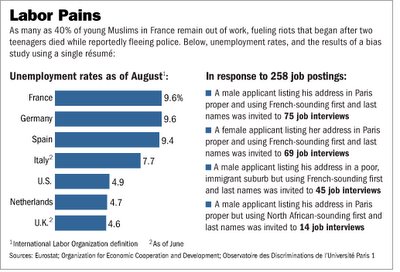
This is why there will be no easy solution to the riots in France. And thus even as the riots subside, the tension will remain. In this environment of disenfranchizement and alienation, islamofascism will find fertile soil.
20051108

FTAA
Lets turn our attention away from the riots in France to the just passed riots at the Summits of the America regarding the 11 years and ongoing work to create a Free Trade Area of the America.
After Bush left Argentina he stopped in Brazil.
MAR DEL PLATA, Argentina -- The Fourth Summit of the Americas attended by President Bush and 33 regional leaders ended here Saturday with a virtual partition of the Americas in two economic and political blocs: one made up of the United States and 28 other countries, and another made up of Brazil and four other countries.
Despite efforts from all sides to put a good face to it, the summit ended in disarray.
Judging from what I've seen in more than two decades of covering nearly every major regional summit, it was the first time participating countries couldn't even agree on a joint final news conference..
More importantly, it was the first time in the 11-year-old history of the Summit of the Americas that participating countries failed to agree on advancing the talks for a hemisphere-wide free trade area.
Since 1994, when the leaders of the Americas met in Miami to propose a Free Trade Area of the Americas, spanning from Alaska to Patagonia, the region's democracies vowed at every summit to speed up the creation of a hemispheric trade bloc. This time, they ended with a bipolar declaration stating that ''one group of countries'' wanted to go ahead with FTAA negotiations, and ''another group of countries'' didn't.
Barring a surprise turnaround at a meeting scheduled for an indefinite date next year, pending the result of worldwide trade negotiations within the World Trade Organization, we are heading to a formal partition of the hemisphere.
One bloc is made up of the United States, Canada, Mexico, Central America, Colombia, Chile, and several other countries, whose combined gross domestic product is an estimated $14.5 trillion. The other emerging bloc is made up of Brazil, Argentina, Venezuela, Paraguay and Uruguay, whose economies add up to about $2.2 trillion.
NOT DEAD YET
Granted, the split is not terminal: while Venezuela's self-described socialist President Hugo Chávez wants to ''bury FTAA for good,'' Argentina's foreign minister Rafael Bielsa noted that the remaining four countries believe that ''the conditions are not there'' for them to continue the FTAA negotiations. They would join them if the United States lifted its subsidies to U.S. farmers, which are hurting South American agricultural exports.
But, judging from my interviews with several presidents and foreign ministers after sneaking into the hotels where they were staying, there is a growing fatigue among the Group of 29, and an escalating desire by some of its smaller members to forget about the holdouts and go it alone, and start an ``FTAA of the willing.''
Venezuela's Chávez does not need an FTAA, because Venezuela is a one-product country that lives on its oil exports, and would not have much else to sell if it obtained preferential access to the other countries.
After Bush left Argentina he stopped in Brazil.
Most reports cast the fourth Summit of the Americas as a showdown between Mr. Bush and Venezuelan strongman Hugo Chávez. To read some of the accounts, you'd think the Chávez vision provided a serious alternative to the continuing expansion of free trade and global competition, and to the prosperity that has come with them. Give the Castro acolyte some credit for media savvy and sound bites -- which is what you have to fall back on when you lose on substance.
And lose Señor Chávez did, because the real action this weekend didn't take place at the summit in Argentina but a day later on the American President's visit to Brazil. Mr. Bush and Brazilian President Lula da Silva went a long way toward agreeing on a common strategy to reduce farm subsidies that just might salvage the Doha round of global trade-opening.
"Your president has criticized the agricultural subsidies that the developed world pays to its farmers -- trade-distorting subsidies that undercut honest farmers in the developing world," Mr. Bush said in a speech in Brasilia. "I agree with President Lula." As Brazil's ambassador to the U.S. told us, "The visit was very constructive, and that fact was really apparent in the Brazilian press."
20051107
The Muslim Streets 2
Too often we talk about the silence of the Muslim world regarding terrorism, and equate this with tacit approval of terrorism. Thus this bit comes as welcomed news from Gateway Pundit:
At the same time, how many times have westerners protested against terrorism?
* 150,000 Demonstrate Against Al Qaida in Morocco
* Protesters Pledge Unity with Iraq!
* "All Moroccans are with Iraq, all Moroccans are innocent," the marchers chanted.
* Rally draws people cutting across political lines
* Officials say they will not succumb to Al Qaida blackmail
* Clerics say Al Qaida members will "burn in hell" if they kill embassy workers
At the same time, how many times have westerners protested against terrorism?
Riots
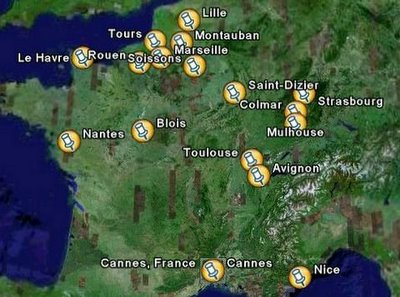
While the map is only of France, riots are also occuring in the Netherlands, Denmark, and Germany.
Elsewhere.
Here are today’s headlines in Belgium’s (only) Sunday newspaper De Zondag. Page One: “No Sign of Revolt in Belgium Yet.” Page Five: “Violence Moves Towards Belgium.” It almost sounds like a weather forecast, anticipating the onslaught of a hurricane that is inevitably coming.
20051106
France's Intifada
The ongoing riots in France are troubling. While certainly economic opportunity is the inciting factor for the grievance, that the population affected consist of Muslim youth is cause for concerns. Whether France is a US ally or not is largely irrelevant if she falls from diplomatic schizophrenia into instability. This will destabilize much of Europe as many other Western European nations are confronting similar crisis, though not so severe. France along with Germany constitute the bulk of continental Western Europe, a region slowly descending into and becoming what some have referred to as Eurabia. Both France and Germany have large Muslim immigrant population, both fail to culturally and politically integrate their Muslim immigrants, and both have faltering economies that will prevent economic integration.
We must also remember that while the ethnicities of the terrorists from the GWoT have been Middle Easterners, most also have lived and been indoctrinated in Europe. In the Middle East, Muslim countries have only themselves to blame, and contain sufficient counterweight to extremism and fundamentalism. And in Iraq and Afghanistan, they have suffered under violent oppression to understand that fundamentalism is not the solution. But Muslims in Europe are disenfranchised and radicalized. In Eurabia fundamentalism can be perceived as “empowering”. The existing terrorist cells will certainly take advantage of these riots, even if they originated in economic grievances. More so, they have westerners to blame and even worse, they will have western collaborators to assist and vocalize their grievances and anger.
France will have to crack down, and likely harshly. There are little cultural, political, or economic offerings available as alternative. How the disenfranchised will react depends on how much their cause and action have been co-opted by the terrorists. But even acts of terrorism will not destabilize France if France retains the will to fight. This has remained the case for numerous countries fighting an insurgency that has resorted to terrorism, whether it be countries in Latin America (Colombia), the Middle East (Algeria, Iraq), or Europe (Spain). But if France will to fight is undermined by actions on France’s political left, and the political naiveté of France’s youth, then instability is certain.
Finally, the US and its true allies in the GWoT will not have the resources short of full mobilization to contain and salvage Eurabia. A destabilized France-Eurabia will be very bad for us, and a lost we may not be able to recover from. While Schadenfreude is tempting, it is shortsighted.
20051104
The Muslim Streets

Where
AS THE night falls, the "troubles" start — and the pattern is always the same.
Bands of youths in balaclavas start by setting fire to parked cars, break shop windows with baseball bats, wreck public telephones and ransack cinemas, libraries and schools. When the police arrive on the scene, the rioters attack them with stones, knives and baseball bats.
The police respond by firing tear-gas grenades and, on occasions, blank shots in the air. Sometimes the youths fire back — with real bullets.
These scenes are not from the West Bank but from 20 French cities, mostly close to Paris, that have been plunged into a European version of the intifada that at the time of writing appears beyond control.
Why
Why have the riots happened? From many accounts one would think that the riots have been caused by France’s failure to implement Marxism. “The unrest,” AP explained, has highlighted the division between France’s big cities and their poor suburbs, with frustration simmering in the housing projects in areas marked by high unemployment, crime and poverty.” Another AP story declared flatly that the riots were over “poor conditions in Paris-area housing projects.”
Reuters agreed with AP’s attribution of all the unrest to economic injustice, and added in a suggestion of racism: “The unrest in the northern and eastern suburbs, heavily populated by North African and black African minorities, have been fuelled by frustration among youths in the area over their failure to get jobs and recognition in French society.” Deutsche Presse Agentur called the high-rise public housing in the Paris suburbs “a long-time flashpoint of unemployment, crime and other social problems.”
One might get the impression from this that France is governed by top-hatted, cigar-smoking capitalists, building their fortunes on the backs of the poor, rather than by socialists and quasi-socialists who have actually strained the economy by spending huge amounts of money on health and welfare programs. Nor does the idea that the rioting has been caused by economic inequalities explain why Catholics and others who are poor in France have not joined the Muslims who are rioting. Of course, all the news agencies have either omitted or mentioned only in passing that the rioters are Muslims at all. The casual reader would not be able to escape the impression that what is happening in France is all about economics — and race.
The areas hardest hit by the riots, according to Reuters, are “home to North African and black African minorities that feel excluded from French society.” AP shed some light on this feeling of exclusion: “the violence also cast doubt on the success of France’s model of seeking to integrate its large immigrant community — its Muslim population, at an estimated 5 million, is Western Europe’s largest — by playing down differences between ethnic groups. Rather than feeling embraced as full and equal citizens, immigrants and their French-born children complain of police harassment and of being refused jobs, housing and opportunities.”
But What about ...
It's a barely kept secret that Mr. Chirac led the opposition to the Iraq war out of fear of how his Muslim population would react. This fear is a big part of why France portrays itself as America's counterweight and why it criticizes Israel at every turn and coddled the terrorist Yasser Arafat right up to his death. This doesn't elicit thanks from Muslim radicals in France. It turns out to project an image of weakness. Unsurprisingly when faced with some unhappiness they believe they can pressure the French state into submission.
20051103
The CIA and Plame
Here is a nice run down of the role of the CIA in Plamegate in today's WSJ
• First: The CIA sent her husband, former Ambassador Joseph Wilson, to Niger on a sensitive mission regarding WMD. He was to determine whether Iraq had attempted to purchase yellowcake, an essential ingredient for nonconventional weapons. However, it was Ms. Plame, not Mr. Wilson, who was the WMD expert. Moreover, Mr. Wilson had no intelligence background, was never a senior person in Niger when he was in the State Department, and was opposed to the administration's Iraq policy. The assignment was given, according to the Senate Intelligence Committee, at Ms. Plame's suggestion.
• Second: Mr. Wilson was not required to sign a confidentiality agreement, a mandatory act for the rest of us who either carry out any similar CIA assignment or who represent CIA clients.
• Third: When he returned from Niger, Mr. Wilson was not required to write a report, but rather merely to provide an oral briefing. That information was not sent to the White House. If this mission to Niger were so important, wouldn't a competent intelligence agency want a thoughtful written assessment from the "missionary," if for no other reason than to establish a record to refute any subsequent misrepresentation of that assessment? Because it was the vice president who initially inquired about Niger and the yellowcake (although he had nothing to do with Mr. Wilson being sent), it is curious that neither his office nor the president's were privy to the fruits of Mr. Wilson's oral report.
• Fourth: Although Mr. Wilson did not have to write even one word for the agency that sent him on the mission at taxpayer's expense, over a year later he was permitted to tell all about this sensitive assignment in the New York Times. For the rest of us, writing about such an assignment would mean we'd have to bring our proposed op-ed before the CIA's Prepublication Review Board and spend countless hours arguing over every word to be published. Congressional oversight committees should want to know who at the CIA permitted the publication of the article, which, it has been reported, did not jibe with the thrust of Mr. Wilson's oral briefing. For starters, if the piece had been properly vetted at the CIA, someone should have known that the agency never briefed the vice president on the trip, as claimed by Mr. Wilson in his op-ed.
• Fifth: More important than the inaccuracies is the fact that, if the CIA truly, truly, truly had wanted Ms. Plame's identity to be secret, it never would have permitted her spouse to write the op-ed. Did no one at Langley think that her identity could be compromised if her spouse wrote a piece discussing a foreign mission about a volatile political issue that focused on her expertise? The obvious question a sophisticated journalist such as Mr. Novak asked after "Why did the CIA send Wilson?" was "Who is Wilson?" After being told by a still-unnamed administration source that Mr. Wilson's "wife" suggested him for the assignment, Mr. Novak went to Who's Who, which reveals "Valerie Plame" as Mr. Wilson's spouse.
• Sixth: CIA incompetence did not end there. When Mr. Novak called the agency to verify Ms. Plame's employment, it not only did so, but failed to go beyond the perfunctory request not to publish. Every experienced Washington journalist knows that when the CIA really does not want something public, there are serious requests from the top, usually the director. Only the press office talked to Mr. Novak.
• Seventh: Although high-ranking Justice Department officials are prohibited from political activity, the CIA had no problem permitting its deep cover or classified employee from making political contributions under the name "Wilson, Valerie E.," information publicly available at the FEC.
20051029
US Economy
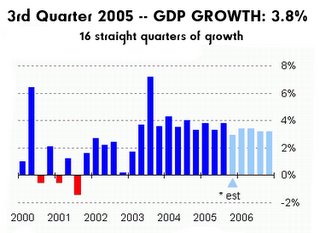
Interesting read from BizzyBlog
QUESTION: When is this economy going to some respect?
The economy’s 3.8% third-quarter growth (subject to revision in the coming months) was remarkable, given the storms that occurred during almost the entire final month of the quarter:Economists had forecast GDP would advance at a 3.6% rate in the July-to-September quarter. The economy has now expanded faster than 3% for 10 straight quarters.
So when was the last time the economy expanded faster than 3% for 10 straight quarters?
It didn’t happen during the 1990s (the longest streak was eight).
It last happened during the 13 quarters from 1Q 1983 through 1Q 1986. Not coincidentally, a president who believed in lowering taxes to stimulate economic growth was in charge the last time it happened.
So despite being at war, despite devastating storms, and despite legislative and regulatory drags on the economy like Sarbanes-Oxley, this has been most consistently growing economy in almost 20 years.
Not only that, the US economy has NEVER had a streak of more than 7 quarters of 3.0% or greater annualized growth at any other time in the 58 years that quarterly GDP statistics have been kept!
HT to Willisms, a great site for figures behind the news.
20051028
Candide
In today's WSJ Science Journal article by Sharon Begley. Is it all just foolish optimism manifested by rationalization?
Our Brains Strive To See Only the Good, Leading Some to God
October 28, 2005; Page B1
Life is full of surprises, but it's rare to reach for a carafe of wine and find your hand clutching a bottle of milk -- and even rarer, you'd think, to react by deciding the milk was actually what you wanted all along.
Yet something like that happened when scientists in Sweden asked people to choose which of two women's photos they found most attractive. After the subject made his choice, whom we'll call Beth, the experimenter turned the chosen photo face down. Sliding it across the table, he asked the subject the reasons he chose the photo he did. But the experimenter was a sleight-of-hand artist. A copy of the unchosen photo, "Grizelda," was tucked behind Beth's, so what he actually slid was the duplicate of Grizelda, palming Beth.
Few subjects batted an eye. Looking at the unchosen Grizelda, they smoothly explained why they had chosen her ("She was smiling," "she looks hot"), even though they hadn't.
In 1966, Time magazine asked, "Is God Dead?" Even then, the answer was no, and with the rise of religion in the public square, the question now seems ludicrous. In one of those strange-bedfellows things, it is science that is shedding light on why belief in God will never die, at least until humans evolve very different brains, brains that don't (as they did with Beth and Grizelda) interpret unexpected and even unwanted outcomes as being for the best.
"Belief in God," says Daniel Gilbert, professor of psychology at Harvard University, "is compelled by the way our brains work."
As shown in the Grizelda-and-Beth study, by scientists at Lund University and published this month in Science, brains have a remarkable talent for reframing suboptimal outcomes to see setbacks in the best possible light. You can see it when high-school seniors decide that colleges that rejected them really weren't much good, come to think of it.
You can see it, too, in experiments where Prof. Gilbert and colleagues told female volunteers they would be working on a task that required them to have a likeable, trustworthy partner. They would get a partner randomly, by blindly choosing one of four folders, each containing a biography of a potential teammate. Unknown to the volunteers, each folder contained the same bio, describing an unlikable, untrustworthy person.
The volunteers were unfazed. Reading the randomly chosen bio, they interpreted even negatives as positives. "She doesn't like people" made them think of her as "exceptionally discerning." And when they read different bios, they concluded their partner was hands-down superior. "Their brains found the most rewarding view of their circumstances," says Prof. Gilbert.
The experimenter then told the volunteer that although she thought she was choosing a folder at random, in fact the experimenter had given her a subliminal message so she would pick the best possible partner. The volunteers later said they believed this lie, agreeing that the subliminal message had led them to the best folder. Having thought themselves into believing they had chosen the best teammate, they needed an explanation for their good fortune and experienced what Prof. Gilbert calls the illusion of external agency.
"People don't know how good they are at finding something desirable in almost any outcome," he says. "So when there is a good outcome, they're surprised, and they conclude that someone else has engineered their fate" -- a lab's subliminal message or, in real life, God.
Religion used to be ascribed to a wish to escape mortality by invoking an afterlife or to feel less alone in the world. Now, some anthropologists and psychologists suspect that religious belief is what Pascal Boyer of Washington University, St. Louis, calls in a 2003 paper "a predictable by-product of ordinary cognitive function."
One of those functions is the ability to imagine what Prof. Boyer calls "nonphysically present agents." We do this all the time when we recall the past or project the future, or imagine "what if" scenarios involving others. It's not a big leap for those same brain mechanisms to imagine spirits and gods as real.
Another God-producing brain quirk is that although many things can be viewed in multiple ways, the mind settles on the most rewarding. Take the Necker cube, the line drawing that shifts orientation as you stare at it. If you reward someone for seeing the cube one way, however, his brain starts seeing it that way only. The cube stops flipping.
There are only two ways to see a Necker cube, but loads of ways to see a hurricane or a recovery from illness. The brain "tends to search for and hold onto the most rewarding view of events, much as it does of objects," Prof. Gilbert writes on the Web site Edge. It is much more rewarding to attribute death to God's will, and to see in disasters hints of the hand of God.
Prof. Gilbert once asked a religious colleague how he felt about helping to discover that people can misattribute the products of their own minds to acts of God. The reply: "I feel fine. God doesn't want us to confuse our miracles with his."
20051027
Work in Peace Harriet Miers
Harriet has withdrew her nomination to SCotUS. I am disappointed, not because I am pro-Miers, but because reasonable due process of evaluation was over taken by hysteria. This weakens the executive branch regardless of who is in power.
Bush's statement
Miers' statement
Bush's statement
Today, I have reluctantly accepted Harriet Miers' decision to withdraw her nomination to the Supreme Court of the United States.
I nominated Harriet Miers to the Supreme Court because of her extraordinary legal experience, her character, and her conservative judicial philosophy. Throughout her career, she has gained the respect and admiration of her fellow attorneys. She has earned a reputation for fairness and total integrity. She has been a leader and a pioneer in the American legal profession. She has worked in important positions in state and local government and in the bar. And for the last five years, she has served with distinction and honor in critical positions in the Executive Branch.
I understand and share her concern, however, about the current state of the Supreme Court confirmation process. It is clear that Senators would not be satisfied until they gained access to internal documents concerning advice provided during her tenure at the White House – disclosures that would undermine a President's ability to receive candid counsel. Harriet Miers' decision demonstrates her deep respect for this essential aspect of the Constitutional separation of powers – and confirms my deep respect and admiration for her.
I am grateful for Harriet Miers' friendship and devotion to our country. And I am honored that she will continue to serve our Nation as White House Counsel.
My responsibility to fill this vacancy remains. I will do so in a timely manner.
Miers' statement
Dear Mr. President:
I write to withdraw as a nominee to serve as an Associate Justice on the Supreme Court of the United States. I have been greatly honored and humbled by the confidence that you have shown in me, and have appreciated immensely your support and the support of many others. However, I am concerned that the confirmation process presents a burden for the White House and our staff that is not in the best interest of the country.
As you know, members of the Senate have indicted their intention to seek documents about my service in the White House in order to judge whether to support me. I have been informed repeatedly that in lieu of records, I would be expected to testify about my service in the White House to demonstrate my experience and judicial philosophy. While I believe that my lengthy career provides sufficient evidence for consideration of my nomination, I am convinced the efforts to obtain Executive Branch materials and information will continue.
As I stated in my acceptance remarks in the Oval Office, the strength and independence of our three branches of government are critical to the continued success of this great Nation. Repeatedly in the course of the process of confirmation for nominees for other positions, I have steadfastly maintained that the independence of the Executive Branch be preserved and its confidential documents and information not be released to further a confirmation process. I feel compelled to adhere to this position, especially related to my own nomination. Protection of the prerogatives of the Executive Branch and continued pursuit of my confirmation are in tension. I have decided that seeking my confirmation should yield.
I share your commitment to appointing judges with a conservative judicial philosophy, and I look forward to continuing to support your efforts to provide the American people judges who will interpret the law, not make it. I am most grateful for the opportunity to have served your Administration and this country.
Most respectfully,
Harriet Ellan Miers
20051025
RIP Rosa Parks

I do have to wonder about the original event, as to whatever happened to the man who had to stand as she sat.
20051023
Predictions 2
Well not doing so well. Texas Tech lost big time to Texas yesterday. While i can detail the errors of Tech special teams and penalty ridden play, a lost is a lost. There is also news from the Washington Times that Bush may withdraw Miers' nomination. This would be a huge mistake imo.
20051021
Predictions
1. Harriet Miers will be supreme court justice
2. Tom Delay will be exonerated.
3. Texas Tech ranked #7 in the BCS will beat Texas on the football field on 10/22/2005.
2. Tom Delay will be exonerated.
3. Texas Tech ranked #7 in the BCS will beat Texas on the football field on 10/22/2005.
20051012
SCotUS Nomination: the bases
Similar to what i previously posted is this analysis from the David Ignatius at the WSJ (Subscription required)
However, i disagree that the moderate republicans are taking potshots. Most of the uproar, if not all, have come from the conservatives.
The bickering over the Miers nomination epitomizes the right's refusal to assume the role of a majoritarian governing party. The awkward fact for conservatives is that the American public doesn't agree with them on abortion rights. A CNN/USA Today/Gallup poll in late August found 54% describing themselves as pro-choice, and only 38% as pro-life, roughly the same percentages as a decade ago.
That's the political reality that Mr. Bush has been trying to finesse with his nominations of John Roberts and Ms. Miers. That's why he said in the 2000 primary campaign that he wouldn't impose any litmus test (when other Republicans were demanding one) and would instead focus on a nominee's character and judicial philosophy. The realist in Mr. Bush understands that he can't easily force a nominee who is openly anti-abortion on a country where a solid majority disagrees.
Mr. Bush has been successful when he has connected with the American center. Political scientist Gary C. Jacobson notes that after Sept. 11, 2001, Mr. Bush "enjoyed the longest stretch of approval ratings above 60% of any president in 40 years." In that post-9/11 period, when Mr. Bush was fulfilling his campaign promise to be "a uniter, not a divider," his approval rating among Democrats soared to an astounding 81%.
Mr. Bush and the Republicans had a chance after 2004 to become the country's natural governing party. They controlled the White House and both houses of Congress. The Democrats were in utter disarray, leaderless and idea-less. When Mr. Bush took the podium in January to deliver his soaring second inaugural address, the future seemed to belong to the Republicans.
Mr. Bush squandered this opportunity by falling into the trap that has snared the modern GOP -- of playing to the base rather than to the nation. The Republicans behave as if the country agrees with them on issues, when that demonstrably isn't so. The country doesn't agree about Social Security, doesn't agree about the ethical issues that were dramatized by the torment of Terri Schiavo, doesn't agree about abortion. Yet in a spirit of blind partisanship, House Speaker Dennis Hastert could announce last year that bills would reach the floor only if "the majority of the majority" supported them. That notion of governing from the hard right was a recipe for failure.
What you sense now, as conservative and moderate Republicans alike take potshots at their president, is that the GOP is entering the post-Bush era. A war of succession has begun, cloaked in a war of principles. The cruelest aspect of Mr. Bush's predicament is that the conservatives are treating him with the same disdain they showed his father. What a denouement to the West Wing Oedipal drama: A son who did everything he could to avoid his father's humiliation by the conservative wing of the party is now under attack by the right himself.
Principles are a fine thing, but a narrow, partisan definition of principle has led the Republicans to a dead end. Their inability to transcend their base and speak to the country as a whole is now painfully obvious. Like the Democrats in their years of decline, they are screaming at each other -- not realizing how far they have drifted from the mid-channel markers that have always led to open waters and defined success in American politics.
However, i disagree that the moderate republicans are taking potshots. Most of the uproar, if not all, have come from the conservatives.
20051010
SCotUS Nominations
The difference between 2000 and 2004 election are the "911 republicans" who gave Bush a majority in 2004. 911 republicans care about waging and winning the global war against islamofascism. They are made up of moderate republicans, true liberals (who believe in freedom and democracy for all), and similarly minded independents. True conservatives probably don't care all that much for the war and would as soon see the US isolationist. Most conservatives tolerated it as a necessity, and because it was the right thing to do. But it is not a core tennet of the conservative agenda. Many conservatives have even come out against the war.
When it comes to social issues, the conservatives really want someone who will pass their litmus test for SCotUS (like overturning Roe vs. Wade). Sure they talk about not legislating from the bench, but this is as long as it serves the conservative agenda. I do believe the conservatives are generally less ideologically blinded than their mirrors on the left, but not by much.
Naturally conservatives, being the core supporters of Bush, feel betrayed with the Miers nomination. But it was the 911 republicans that won the 2004 election for Bush. It was the moderates that came out for fighting against islamofascist in the name of security that put him over the top. It will be tacking too far right that will lose seats for the Republicans in the next elections. Thus Bush went for vanilla conservative with Roberts, and stealth moderate-conservative with Miers, to appease the right without alienating the middle. And chances are, he also realize he will likely nominate a 3rd candidate for SCotUS before the end of his tenure. With sufficient republican gains in congress to avoid a filibuster, he will then nominate a "true" conservative. He will no longer worry about the nest election. By the 2008 election, a new face will arrive to recruit votes from the moderate base for the republicans. The SCotUS will be a done deal by then and unlikely to be an election issue.
By being too vocal against Miers the conservatives will likely fracture the Republican electoral base and the democrats will be emboldened. If the Republicans lose seats in congress in 2006 they will be even weaker to manage the threat of filibuster. That will cost them the 3rd nomination. Even worse if the next president is a democrat, who will then likely nominate at least one to SCotUS. Politics is a game of tactics. You have to look 2 moves ahead to win.
A related article at Opinion Journal
20051008
Media Mole Hill
Interesting that whatever the media first report, most seems to be inaccurate the further you delve into it. The latest was the "racist" comment by "Bill Bennett." Thus this should come as no surprise.
If i was into conspiracy theories, i would suggest this last was the foreseen, if not the intended, consequence.
For those who missed the first round of stories, Bennett took a call from a listener who suggested that Social Security might not be in financial difficulty were it not for the millions of abortions that have occurred in recent decades (because, presumably, more young people would be paying into the trust fund). Bennett responded that arguing for or against abortion based on such consequentialist considerations was dangerous because it "cuts both [ways]": "If you wanted to reduce crime, you could -- if that were your sole purpose -- you could abort every black baby in this country, and your crime rate would go down. That would be an impossible, ridiculous, and morally reprehensible thing to do, but your crime rate would go down. So these far-out, these far-reaching, extensive extrapolations are, I think, tricky."
Let us walk, slowly and carefully, through this minefield and see what it shows.
FIRST, IT SHOWS how superficial American political discourse has become -- in several different ways. Bennett was trying to demonstrate to the caller, albeit clumsily, the error of judging the morality of a practice based on the results of the practice.
The caller suggested abortion was bad because it led to bad consequences (i.e., inadequate contributions to the Social Security trust fund). Bennett provided a counter-example: lower crime. If we say abortion is bad because it reduces Social Security contributions, then should we say it is good if it reduces crime? Bennett was attempting to show that arguing backward from consequences can lead to "impossible, ridiculous, and morally reprehensible" positions. The utilitarian calculus of consequentialist ethics involves no regard for important but not easily quantifiable values, such as individual rights and the inherent dignity of every human being.
Stupidly, Bennett clouded the debate by bringing race into the conversation. But because he did bring race into the discussion, a couple of other points bear noting.
The first is a simple mathematical fact: African-Americans commit more crimes, per capita, than whites (though not more crimes in the aggregate). The principal victims of African-American criminals are also African-American. In Richmond in 2002, for instance, 63 of the city's 84 homicide victims were black males. That year a black male in Richmond between 18 and 34 had a higher chance of dying by violence than an African-American serviceman fighting in Iraq; statistically, he was more than twice as likely to die by violence here than in the war zone. This went unremarked by Bennett's critics. But failing to face up to the facts does no good to anyone, least of all to the young men who confront such depressingly awful odds.
HERE IS another point: African-Americans make up 13 percent of the U.S. population, but they have 32 percent of the abortions. More than 12 million black children have been aborted since the 1973 ruling in Roe v. Wade. Of the roughly 1 million abortions that will occur this year, about a third will end the life of a black baby.
If i was into conspiracy theories, i would suggest this last was the foreseen, if not the intended, consequence.
20051005
Historical Revision at the UN
From today's Opinion Journal an interesting tibit brought to you by Claudia Rosett, our favorite observer of the UN.
This year, amid the U.N. festivities over its own 60th birthday and high-minded aims, the General Assembly was even busier than usual. So the U.N. folded Taiwan's request for equitable representation in with a new request sent over by Mr. Hsia, for the U.N. to uphold its own charter by actively promoting peace in the Taiwan Strait--which is lined on the communist side with missiles targeted on Taiwan. Red China, backed by Pakistan, opposed both items. Gambia and Chad argued for Taiwan. The U.N. allotted 24 minutes for the entire debate, and then briskly dismissed it as not worth including in the official agenda of the General Assembly.
Borrowing a page from George Orwell, the U.N. also celebrated its anniversary with a poster in the lobby of its famous but decrepit headquarters, on which it advertised a display of "Original Signatories of the U.N. charter." Except they weren't. The original signatory for China of the U.N. charter was the Republic of China. In the 2005 U.N. version, the signatory listed was "China, People's Republic of." Informed of this Turtle Bay twisting of history, Mr. Hsia wrote to U.N. Undersecretary-General Shashi Tharoor, noting, "It is hard to imagine how the U.N., perhaps the world's most important international organization and one which is widely counted on to preserve the truth, could allow itself to blatantly deviate from history and misinform the world about something so fundamental to its history."
The U.N. did not write back, says Mr. Hsia, nor did the U.N. correct the mistake. Instead, in the finest tradition of Orwell's memory hole--the poster simply vanished.
Subscribe to:
Posts (Atom)